



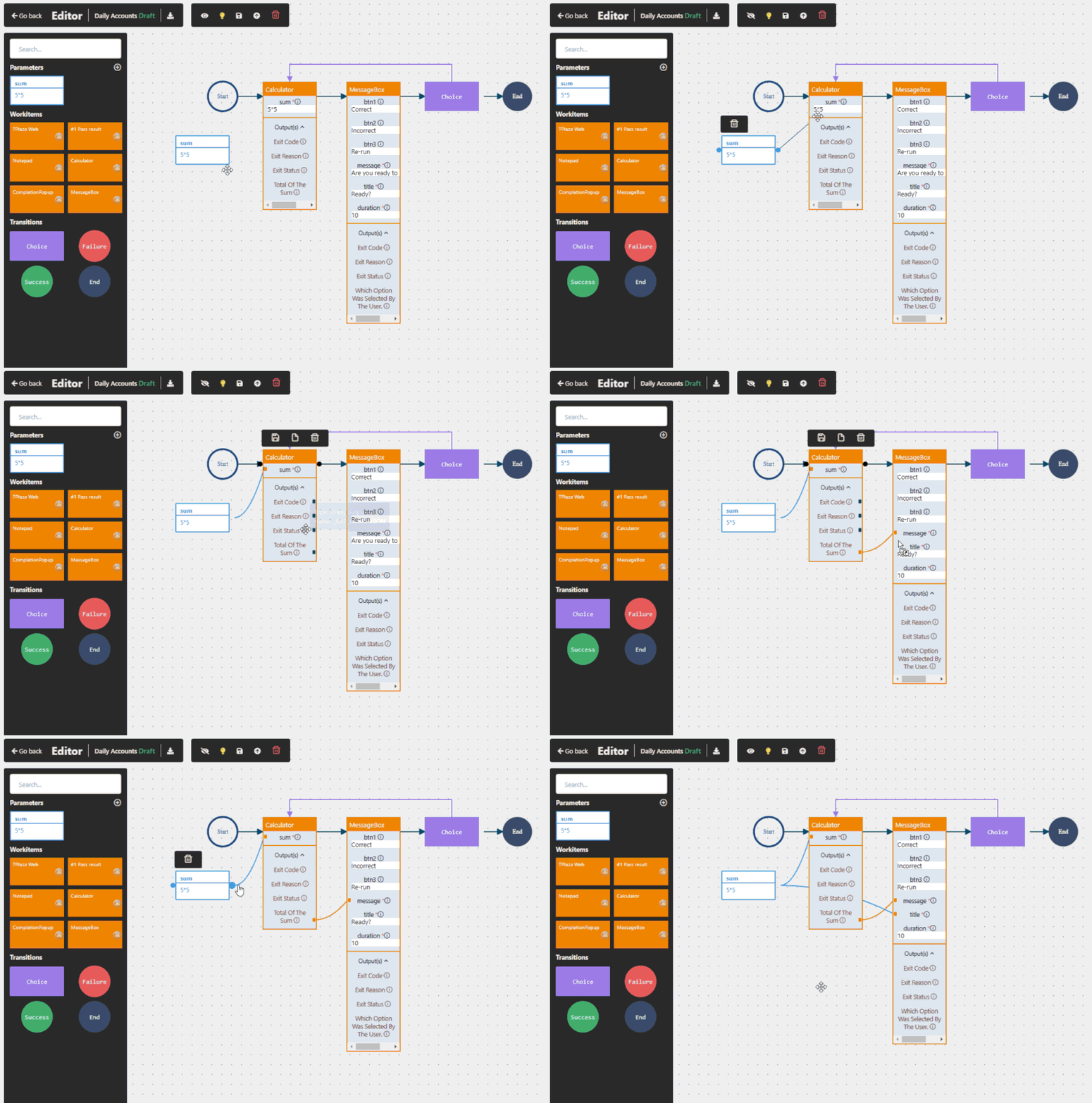
The ADAS testing process typically includes requirements validation, model-based development checks, simulation, hardware-in-the-loop testing and controlled vehicle trials. Final stages focus on validating the human–machine interface, ensuring alerts and dashboard behaviour are accurate and consistent across environments.
ADAS Testing
Testing Across Simulation and Vehicle Environments
Advanced Driver Assistance Systems require structured, repeatable validation of driver-facing alerts, workflows and embedded interfaces.
T-Plan enables non-invasive ADAS system testing across simulation and controlled vehicle environments without modifying certified software builds.
- End-to-end validation of driver alerts and HMI workflows
- Non-invasive automation within embedded environments
- In-vehicle and lab-based execution support
- Scalable regression across firmware and vehicle variants.

ADAS Validation Lifecycle
AUTOMOTIVE SAFETY & SENSOR TESTING WORKFLOW
Standard Industry Steps
T-Plan Accelerated Stages
Accelerating HMI Validation Within the ADAS Lifecycle
ADAS validation spans model-based development, simulation, HIL environments and controlled vehicle trials. The human–machine interface layer remains one of the most visible and risk-sensitive stages, where visual alerts and driver notifications must behave precisely as specified.
T-Plan introduces structured, repeatable regression at this interface layer, strengthening validation without replacing sensor or control system testing.
By automating visual verification of instrument clusters, HUD elements and safety notifications, validation teams can:
- Re-execute interface checks across firmware revisions
- Detect workflow inconsistencies between simulation and vehicle builds
- Validate production-ready software without intrusive agents
- Maintain auditable visual evidence for compliance processes
Rather than replacing sensor or control system validation, T-Plan reinforces the final human–machine verification stage that directly impacts driver safety and user trust.
Automotive Validation Expertise Built Over 25 Years
For more than two decades, T-Plan has supported automotive testing across IVI systems, HUDs and driver-facing interfaces. As vehicle software has evolved from isolated modules to integrated, safety-critical ecosystems, the need for reliable visual validation has only increased.
Our image-based automation platform enables non-invasive, end-to-end validation of ADAS and embedded vehicle systems without altering certified environments, introducing intrusive agents or modifying production-ready builds.
T-Plan has supported engineering teams across global automotive and defence programmes, including organisations such as Saab and MITRE, where structured, repeatable validation is critical.




Key Benefits of ADAS Testing With T-Plan
Modern Advanced Driver Assistance Systems (ADAS) operate within complex, safety-critical and often closed automotive environments. T-Plan’s ADAS testing tools enable scalable, non-invasive validation of driver-facing systems across simulation and in-vehicle testing environments.
No-Code
Required
An intuitive drag-and-drop interface simplifies ADAS system testing for both engineers and validation teams.
Create Once, Repeat Anywhere
Define automated workflows once and execute them across multiple vehicle variants, firmware versions and test environments.
Record and
Playback
Capture real driver interactions with dashboards and safety alerts, then replay them for consistent regression coverage.
External Data
Integration
Drive ADAS testing software using live data feeds, APIs and structured inputs to simulate realistic driving scenarios.
Screen-Level
Automation
Interact directly with instrument clusters and embedded displays at the visual layer, without modifying certified vehicle software.
Multi-Platform
Support
Execute ADAS vehicle testing across simulation labs, controlled test vehicles and development environments.
Image-Based for True End-User Simulation
Verify visual outputs exactly as drivers see them, ensuring accurate alert behaviour and interface consistency.
Third-Party
Integrations
Integrate with structured development and validation workflows to support end-to-end ADAS testing processes.
Why Choose T-Plan For ADAS Testing?
ADAS environments often involve embedded, safety-certified and closed systems where intrusive test tools are not viable. T-Plan provides visual, non-invasive ADAS testing tools designed specifically for validating driver-facing systems in complex automotive environments.
- Visual validation of driver interfaces
Test instrument clusters, dashboards and safety alerts exactly as the driver sees them. - Works in closed and embedded systems
Operate without requiring API hooks or modification of certified vehicle software. - Non-invasive automation
Interact at screen level to validate production-ready builds without compromising system integrity. - Supports legacy and complex architectures
Enable structured ADAS system testing even where traditional automation tools cannot integrate. - Scalable regression testing
Repeat consistent validation across firmware updates, model variants and test environments.
Why Use Automated ADAS Testing?
Advanced Driver Assistance Systems (ADAS) increasingly rely on complex user interfaces, visual alerts and embedded control systems. In many cases, these environments are closed, safety-certified or difficult to integrate with traditional testing tools.
Automated ADAS testing enables consistent validation of driver-facing systems without intrusive access to vehicle software. By interacting directly with dashboards, instrument clusters and display units, automation supports reliable testing of visual behaviour in real-world conditions.
Key advantages include:
- Visual validation of safety-critical alerts
Confirm that warnings, notifications and indicators appear correctly across configurations. - Support for embedded and closed systems
Operate within restricted or legacy environments where API-level access is limited. - Non-invasive interaction
Validate production-ready builds without modifying certified automotive software. - Repeatable regression coverage
Re-run structured tests across firmware updates and system variants. - Scalable validation across environments
Support simulation rigs, lab environments and controlled vehicle testing setups.
Trusted by Hundreds of Companies and Used by Thousands of People for Over 25 Years
































Explore Our Solutions
By Job
Explore Our Solutions
Your Quality Assurance Testing Tool
T-Plan has over 20 years’ experience of desktop software test automation. We recognise how detail-driven accountancy is. Similarly, that delivering both HMRC compliance precision and an ultra-efficient, cost-effective client service is vital.
Moreover, the move to cloud-based accounting is right here, right now. Could quality issues get in the way?
The solution is as essential as a tax return.
T-Plan Robot can be your first choice for black box GUI automation. It automates the testing of software or business processes on a desktop or a mobile at end-user level, mimicking the work that a human being would do. Yet, more efficiently, much faster, without errors, and with no need for holidays or days off.
With no need for modification to the system or application under automation, there’s no “intrusion” necessary.
Software Testing for the Accountancy Sector
Our aim is to improve the quality, predictability and overall performance of accountancy applications, software and processes. With automated testing from T-Plan, any system bugs will be picked up before the product goes into production. And, of course, a long time before it reaches your end users.
repetitive, lower-level testing tasks, you could save hundreds of working hours. The benefits are clear: cost savings, with improved accuracy and efficiency.
Is your end product fit for purpose? With Robot, you’ll know.
This is T-Plan Robot.
T-Plan’s test automation software automates any type of application that employs a User Interface. It’s an “image-based” automation tool that’s tailored to your needs.
Technology Agnostic
We’re proud of our unique non-partisan, technological approach. Supporting Java, T-Plan robot works super-efficiently across all desktop platforms, including Linux, Windows and Mac, as well as on both iOS and Android mobiles.
Further, whether you operate Chrome, Internet Explorer, Firefox or any other browser, Robot won’t discriminate. It’s the automated testing tool that does all the hard work for you.
T-Plan’s solution is affordable: there’s no need for separate licenses. Robot works across all systems and all environments.
T-Plan’s Test Anything, Anywhere Automation Software
- Automate with better control for your complete application range or select the most important ones.
- Choose the testing scenario you need to automate, then T-Plan Robot will record and then repeat it, as often as you need – with enhancements if required.
- Create execution schedules, as well as workflow rules and pass custom parameters for intelligent decision handling.
- You can even build appropriate tests into long-term software development projects. And, test for scalability, too.
- Use the Command Line to interact remotely with your test environment. You can integrate Robot into your existing frameworks and toolsets using the built-in CLI capability.
ADAS Testing FAQs
ADAS testing is the structured validation of Advanced Driver Assistance Systems to ensure alerts, driver notifications and system behaviours operate as specified. It includes simulation, hardware-in-the-loop environments and in-vehicle validation. Visual and HMI testing plays a critical role in confirming driver-facing outputs.
ADAS stands for Advanced Driver Assistance Systems. These systems support vehicle safety and driver awareness through features such as lane assistance, collision warnings and adaptive cruise control.
ADAS systems combine software, embedded control units and physical sensors. While perception and control algorithms operate at system level, ADAS testing software is used to validate system behaviour, interface responses and workflow accuracy within simulation and vehicle environments.
ADAS system testing verifies the interaction between sensors, control logic and driver-facing interfaces. It ensures that trigger events correctly generate alerts, warnings and dashboard outputs under defined driving scenarios.
Common ADAS testing methods include:
- Simulation and model-based testing
- Hardware-in-the-loop testing
- Controlled track and road testing
- Human–machine interface validation
Each stage confirms different aspects of system behaviour and safety compliance.
ADAS capability levels range from Level 0 (no automation) to Level 5 (full automation), as defined by SAE standards. Testing requirements increase significantly at higher automation levels due to the complexity of decision-making and safety validation.
ADAS calibration ensures sensors such as cameras and radar are physically aligned after installation or repair. ADAS testing validates system behaviour, alert logic and interface responses during development and validation phases.
ADAS testing tools support human–machine interface validation by automating the visual confirmation of dashboard alerts, warnings and driver notifications. This ensures consistent behaviour across simulation, lab and in-vehicle environments without modifying embedded software.