A Guide to Automated Functional Software Testing
Automated functional testing is a critical component of modern software development. As applications become more complex and release cycles accelerate, organisations must ensure that functionality performs reliably across every environment and user interaction.
This automated functional testing guide explores how teams can move from manual processes to scalable, efficient testing strategies. Whether you’re evaluating tools, building a framework, or refining your approach, understanding how to automate functional testing effectively is key to delivering high-quality software.
What is Automated Functional Testing?
Automated functional testing is the process of using software tools to verify that an application behaves according to defined requirements. It focuses on validating user-facing functionality, ensuring that features work as expected under real-world conditions.
Functional testing automation replaces repetitive manual checks with scripts that can be executed consistently across multiple environments. This improves accuracy, reduces human error, and allows teams to scale testing efforts efficiently.
With over 25 years of experience in GUI test automation, T-Plan has seen automated functional testing evolve into a strategic capability for organisations operating in fast-paced and highly regulated environments.
Can Functional Testing Be Automated?
Yes, functional testing can be automated, and in many cases, it should be.
However, not all tests are equally suited for automation. The most effective candidates include:
- Regression testing
- Repetitive workflows
- Cross-platform UI validation
- High-risk business-critical processes
Automating functionality testing in these areas allows teams to achieve faster feedback cycles and improved test coverage, while reserving manual testing for exploratory or usability-focused scenarios.
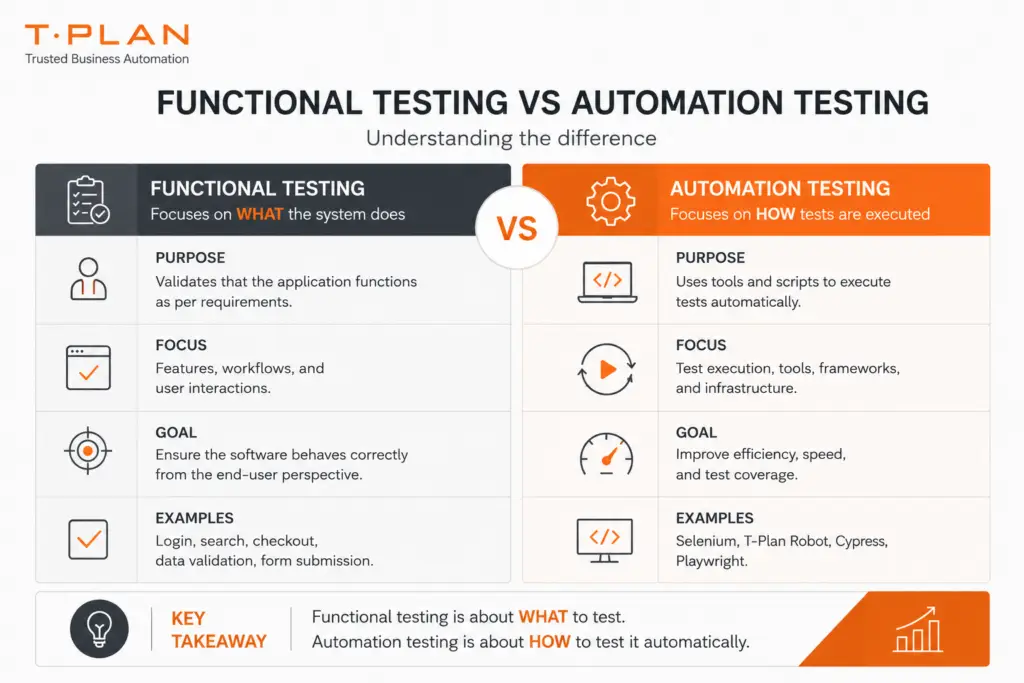
Automated Functional Testing vs Automation Testing
A common point of confusion is the difference between functional testing and automation testing.
- Functional testing focuses on what the system does—validating features and behaviours against requirements.
- Automation testing refers to how testing is executed—using tools and scripts to run tests automatically.
This means functional testing can be either manual or automated. Automation is simply the method used to execute those tests at scale.
Understanding this distinction helps organisations design more effective and targeted testing strategies.
Types of Functional Testing You Can Automate
Functional testing automation can be applied across multiple layers of an application:
UI Testing
Validates user interfaces and workflows. This is where functional UI testing automation plays a critical role, ensuring consistent user experiences across devices and platforms.
API Testing
Ensures backend services and integrations behave correctly, often faster and more stable than UI tests.
Integration Testing
Verifies that different system components work together as expected.
Regression Testing
Confirms that new changes have not introduced defects into existing functionality, one of the most valuable areas to automate.
Functional Test Automation Frameworks
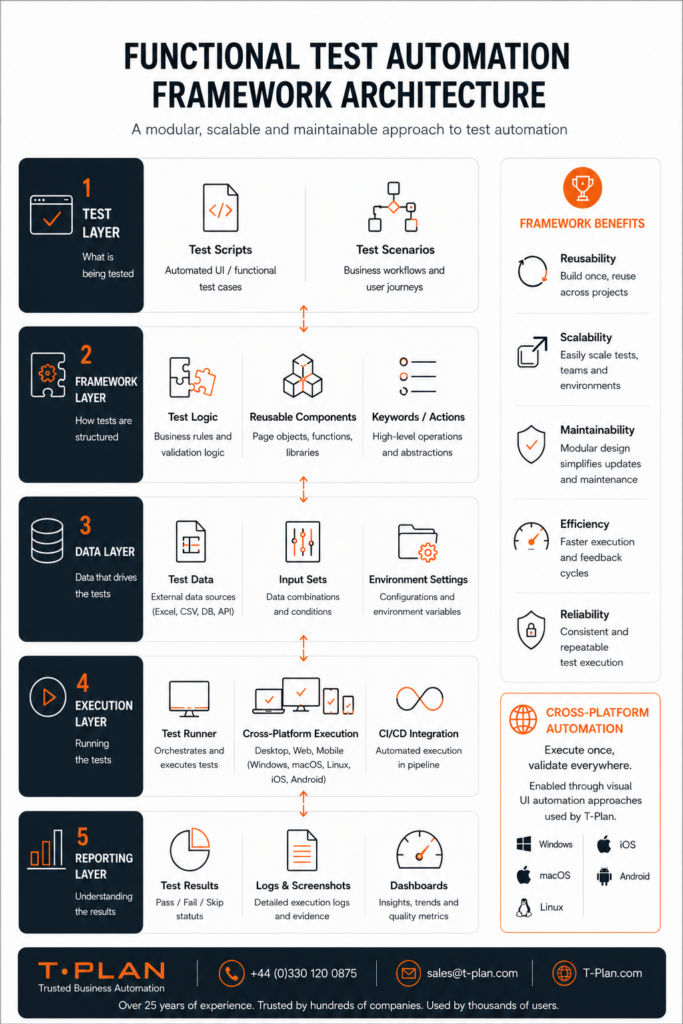
A functional test automation framework provides the structure and guidelines for creating, managing, and executing automated tests.
Common framework types include:
- Data-driven frameworks – Separate test data from scripts for flexibility
- Keyword-driven frameworks – Use predefined actions for reusable testing
- Hybrid frameworks – Combine multiple approaches for scalability
- Model-based frameworks – Generate tests based on system models
Choosing the right functional test automation framework is essential for maintaining efficiency and scalability as testing requirements grow.
Benefits of Automated Functional Testing
Implementing automated functional testing delivers measurable advantages:
- Speed – Execute tests significantly faster than manual processes
- Accuracy – Reduce human error and improve consistency
- Repeatability – Run the same tests across multiple environments
- Scalability – Expand test coverage without proportional resource increases
- Cross-platform validation – Ensure consistent performance across systems
Organisations operating in high-security and time-sensitive environments have demonstrated the ability to significantly accelerate testing cycles while maintaining strict reliability standards.
Challenges of Functional Testing Automation
While the benefits are clear, there are challenges to consider:
- Test maintenance – Scripts require updates as applications evolve
- Flaky tests – Unstable tests can reduce confidence in results
- Tool limitations – Not all solutions support complex environments
- Skill gaps – Teams may require training to implement automation effectively
Addressing these challenges requires the right tools, frameworks, and processes.
Automated Functional Testing Best Practices
To maximise the value of functional testing automation, organisations should follow established best practices:
- Focus on high-value, repeatable test cases
- Design modular and reusable test scripts
- Maintain clear and structured test data
- Prioritise cross-platform compatibility
- Integrate testing into CI/CD pipelines
- Regularly review and optimise test suites
Adopting these automated functional testing best practices ensures long-term sustainability and performance.
How to Automate Functional Testing
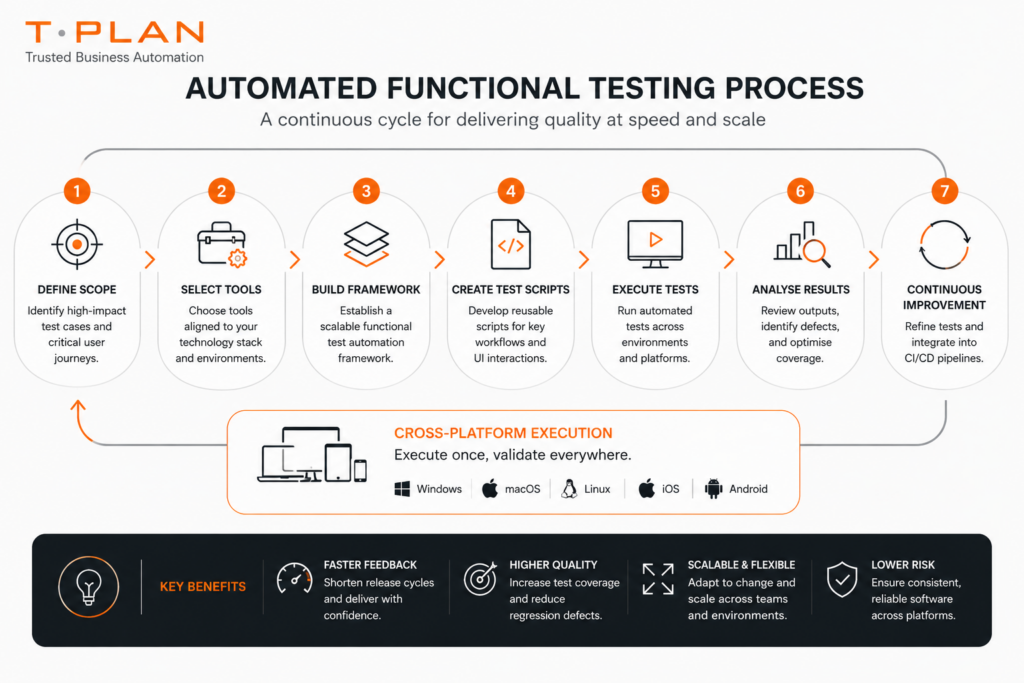
A structured approach is essential when introducing automation functional testing:
1. Define Scope
Identify which tests should be automated based on impact and repeatability.
2. Select Tools
Choose tools that align with your technology stack and testing requirements.
3. Build a Framework
Establish a scalable functional test automation framework.
4. Create Test Scripts
Develop scripts for key workflows and user journeys.
5. Execute and Refine
Run tests continuously, analyse results, and improve coverage over time.
Automated Functional Testing Process
Tools for Functional UI Test Automation
Selecting the right tools is critical for success in functional UI testing automation.
Modern solutions fall into three broad categories:
- Visual automation tools – Ideal for UI-driven applications
- Code-based frameworks – Provide flexibility for technical teams
- Hybrid solutions – Combine ease of use with advanced capabilities
Solutions like T-Plan enable teams to automate testing across multiple platforms using a low-code or no-code approach, reducing the barrier to adoption while maintaining flexibility.
Some organisations have been able to install, configure, and begin executing automated functional tests in minutes, dramatically accelerating time to value.
Real-World Example: Functional Testing Automation in Practice
In high-stakes environments such as defence and public health, automated functional testing plays a critical role in ensuring reliability and compliance.
One organisation required cross-platform validation for a critical application under tight time constraints. By implementing functional UI testing automation, they were able to:
- Reduce manual testing effort
- Improve cross-platform consistency
- Accelerate deployment timelines
The ability to rapidly create and execute test scripts enabled their team to deliver reliable software in a time-sensitive environment.
Conclusion
Automated functional testing is a cornerstone of modern software delivery. It enables organisations to validate functionality at scale, reduce risk, and maintain consistent user experiences across increasingly complex systems.
By implementing the right functional testing automation strategy, supported by robust frameworks and tools, teams can move faster without compromising quality.
For organisations seeking precision, flexibility, and scalability in functional UI testing automation, a structured approach combined with proven technology can deliver immediate and long-term value.
FAQs: Automated Functional Testing
Automated functional testing is the process of using software tools to verify that an application’s features and functionality behave as expected. It focuses on validating user interactions, workflows, and system outputs against defined requirements, while automation enables these tests to run quickly and consistently across multiple environments.
Yes, functional testing can be automated, particularly for repetitive and high-value test cases such as regression testing, UI workflows, and cross-platform validation. However, exploratory and usability testing are typically better suited to manual approaches.
Functional testing focuses on what the system does—ensuring features work as intended—while automation testing refers to how tests are executed using tools and scripts. Functional testing can be performed manually or automated depending on the use case.
Automated functional testing improves speed, accuracy, and scalability. It enables teams to execute tests more frequently, reduce human error, and ensure consistent performance across different platforms. This is particularly valuable in fast-paced development environments where rapid releases are required.
A functional test automation framework is a structured approach to organising and executing automated tests. It separates components such as test scripts, data, execution logic, and reporting, making tests more reusable, maintainable, and scalable as applications evolve.
Functional UI testing automation tools range from code-based frameworks to visual, low-code solutions. The right tool depends on your application, team expertise, and need for cross-platform testing. Modern tools enable teams to automate tests across desktop and mobile environments with minimal setup.