A Guide to RPA in the Automotive Industry
The automotive industry is undergoing rapid digital transformation, driven by electrification, connected vehicles, and increasingly complex global supply chains. To remain competitive, organisations must optimise operations, reduce costs, and improve accuracy across both manufacturing and back-office functions.
Robotic Process Automation (RPA) is playing a critical role in this transformation. By deploying intelligent software bots to automate repetitive, rule-based processes, automotive organisations can achieve greater efficiency, scalability, and operational resilience.
This guide explores rpa in automotive industry, including key challenges, practical applications, and high-impact use cases.
The Challenge
Before implementing RPA, many automotive organisations face persistent operational challenges:
- Complex, global supply chains creating inefficiencies and delays
- High volumes of repetitive, manual processes
- Legacy systems limiting integration and automation
- Strict compliance and regulatory requirements
- Continuous pressure to reduce operational costs
These challenges reflect those seen in regulated environments where automation must balance speed, accuracy, and compliance
What is RPA in the Automotive Industry?
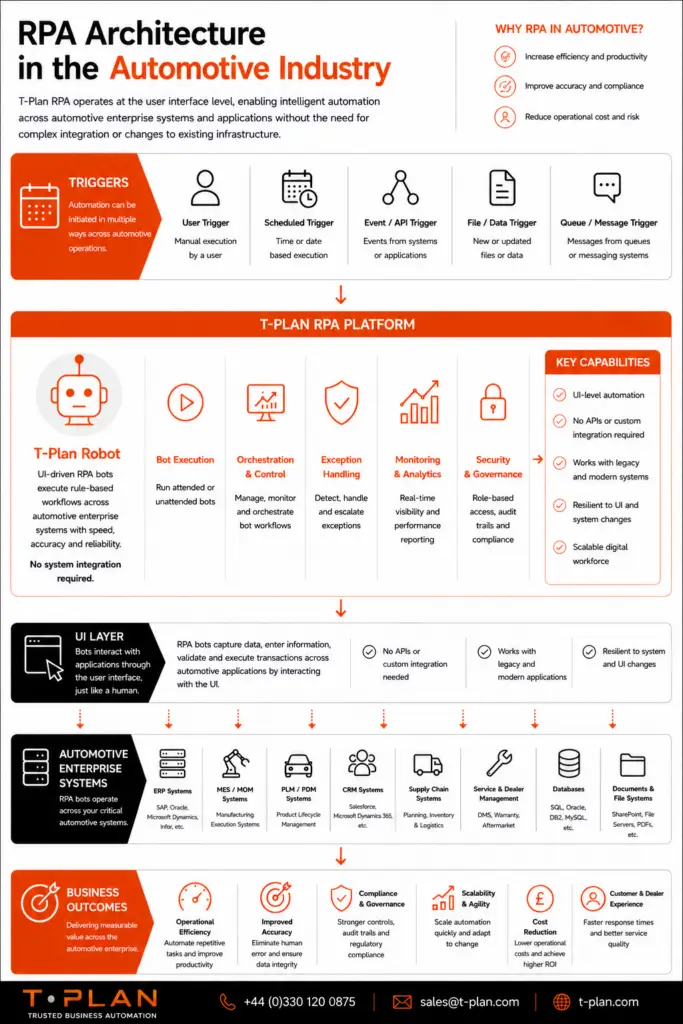
RPA automotive solutions use software bots to replicate human interactions with digital systems, executing tasks such as data entry, validation, reporting, and system integration.
Unlike traditional automation, RPA operates at the user interface level, enabling organisations to automate processes without replacing existing infrastructure.
Modern automotive environments span complex digital ecosystems, from ADAS testing systems to in-vehicle infotainment platforms, all of which require robust, scalable automation.
Key characteristics include:
- Non-intrusive integration with legacy systems
- Scalable digital workforce (rpa bots automotive)
- High accuracy and consistency
- Rapid deployment and measurable ROI
RPA Use Cases in Automotive Industry
Supply Chain & Procurement
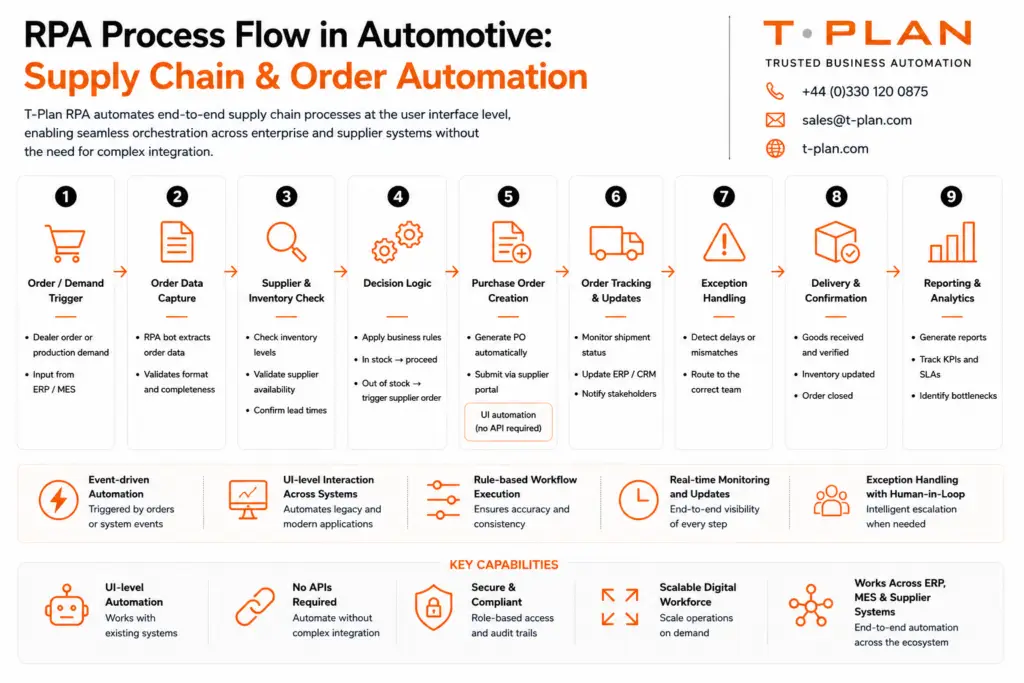
- Supplier onboarding and validation
- Purchase order processing
- Inventory reconciliation
Manufacturing & Production
- Production scheduling updates
- Data capture from shop-floor systems
- Quality assurance validation
Finance & Accounting
- Invoice processing
- Accounts payable and receivable
- Financial reconciliation
Customer Service & Aftermarket
- Service request automation
- Warranty claims processing
- CRM updates
Compliance & Reporting
- Audit trail generation
- Regulatory submissions
- Documentation validation
RPA in Automotive Software & Testing Environments
- Automation of ADAS validation workflows
- Infotainment system UI testing and validation
- Cross-platform regression testing across environments
- Test data management and reporting
- UI-driven automation across complex automotive systems
Advanced Automotive RPA Use Cases
As automation evolves, automotive rpa use cases are expanding into more advanced areas:
- Connected vehicle data processing
- Dealer network automation
- EV infrastructure support
- AI-enhanced RPA for predictive maintenance
Why RPA Matters in Automotive
Operational Efficiency
Automation removes repetitive tasks, improving productivity and freeing teams to focus on higher-value activities.
Scalability
Digital workers can scale instantly to meet fluctuating demand without increasing headcount.
Accuracy & Reliability
Automation ensures consistent execution, reducing human error and improving output quality.
Cost Reduction
Lower operational overheads through process optimisation and reduced manual effort.
Rapid Implementation
Automation solutions can be deployed quickly, delivering immediate operational benefits.
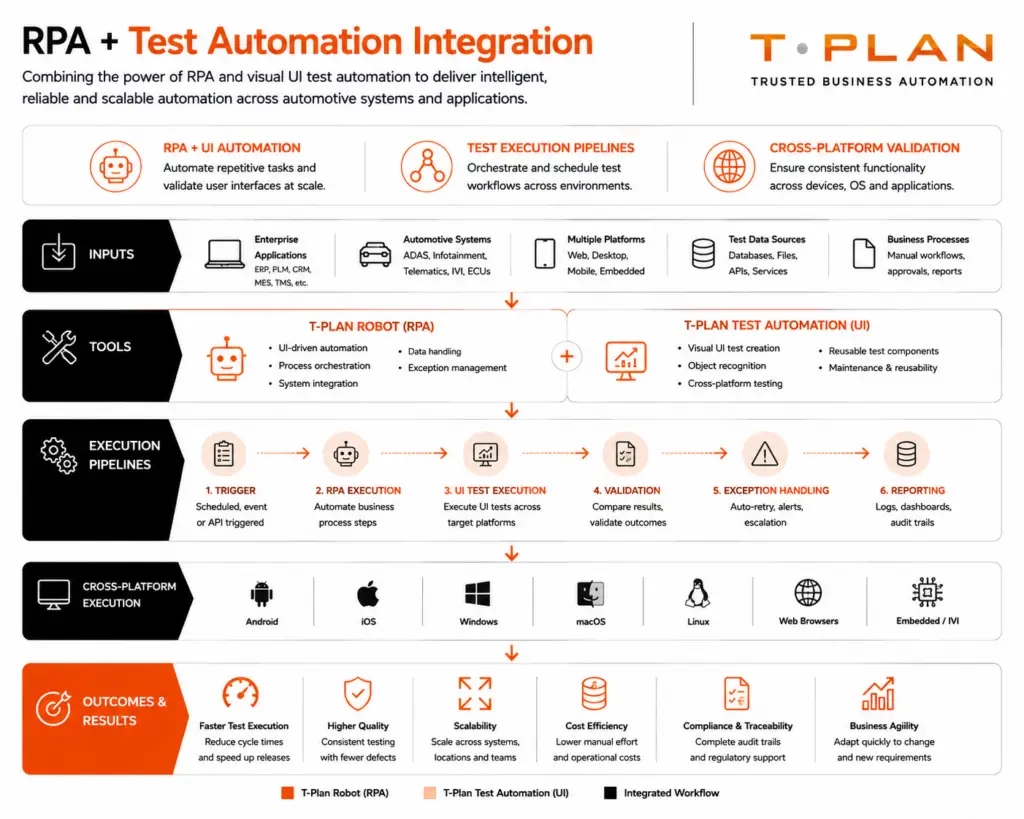
How T-Plan Supports Automotive RPA
With over 25 years of expertise, T-Plan delivers robust, flexible automation solutions tailored to complex industries.
Key Benefits
- Cross-platform automation across desktop and mobile environments
- Rapid deployment with fast time-to-value
- Low-code and no-code usability
- Adaptability to evolving business requirements
- Cost-effective scaling for long-term growth
These capabilities align with T-Plan’s commitment to delivering trusted, scalable business automation.
Best Practices for Implementing RPA in Automotive
To maximise success:
- Prioritise high-volume, rule-based processes
- Establish strong governance and compliance frameworks
- Integrate strategically with existing systems
- Start with targeted automation and scale incrementally
- Continuously measure performance and ROI
Conclusion
RPA is now a strategic enabler within the automotive sector, supporting organisations in navigating increasing complexity and competitive pressure.
By adopting rpa in automotive industry solutions, businesses can:
- Streamline operations
- Improve compliance and accuracy
- Enhance customer experience
- Scale efficiently
With the right automation strategy and technology partner, automotive organisations can unlock measurable value and future-proof their operations.
RPA in the Automotive Industry: FAQs
RPA is used to automate repetitive, rule-based processes across automotive operations, including supply chain management, manufacturing workflows, finance processes, and customer service functions. It enables organisations to improve efficiency without requiring changes to existing systems.
Yes. RPA operates at the user interface level, allowing it to interact with legacy systems, ERP platforms, and modern applications without requiring APIs or system integration. This makes it particularly valuable in complex automotive IT environments.
Processes that are repetitive, rules-based, and high-volume are ideal. This includes purchase order processing, inventory reconciliation, invoice handling, warranty claims, and compliance reporting.
RPA can automate supplier onboarding, order processing, inventory checks, and shipment tracking. This improves visibility, reduces delays, and ensures more accurate data across supply chain systems.
RPA is highly scalable. Organisations can deploy additional bots to handle increased workloads without significant infrastructure changes, enabling them to respond quickly to demand fluctuations.