A Guide to RPA Architecture
As organisations scale their automation initiatives, the underlying architecture of their Robotic Process Automation (RPA) implementation becomes increasingly important.
While many teams begin with isolated automation projects, long-term success depends on building a structured, scalable and secure automation framework. Without this, organisations risk creating fragmented workflows, inconsistent performance and increased maintenance overhead.
RPA architecture provides the foundation for effective automation.
It defines how bots are developed, deployed, managed and integrated across systems, ensuring that automation initiatives remain reliable, secure and scalable as they grow.
In this guide, we explore the core components of RPA architecture, how it works in practice and the key considerations for designing a robust automation framework.
What is RPA Architecture?
RPA architecture refers to the framework of technologies, components and processes that enable the design, deployment and management of software bots.
It defines how different elements of an RPA solution interact, including:
- Bot development environments
- Execution environments
- Control and orchestration systems
- Integration with business applications
A well-designed RPA architecture ensures that automation can be scaled efficiently while maintaining performance, security and governance.
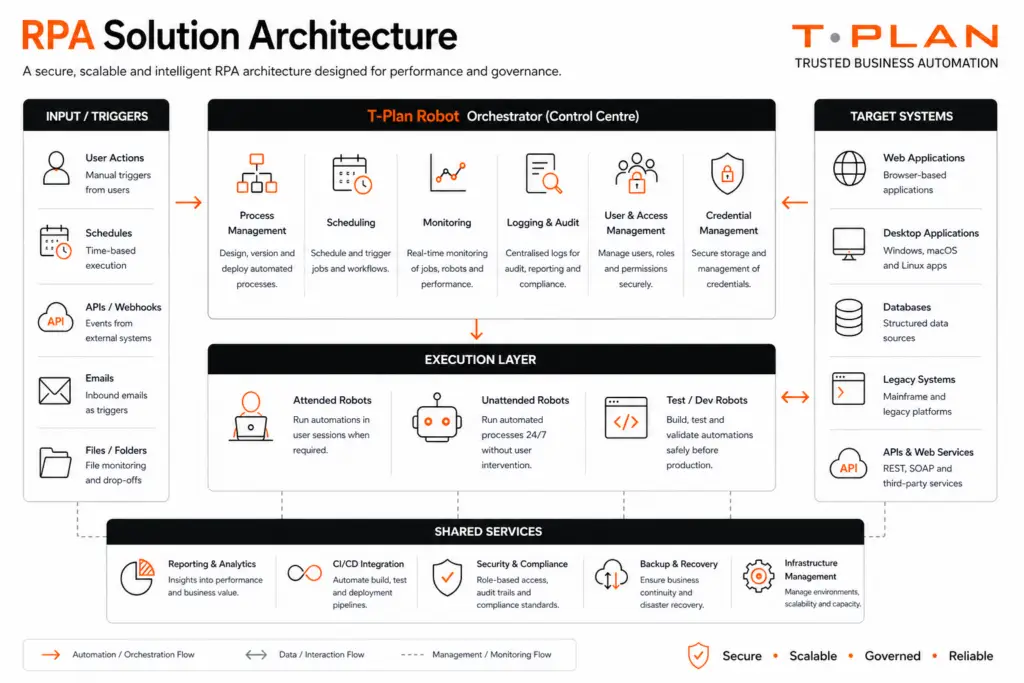
Core Components of RPA Architecture
A typical RPA architecture consists of several key components that work together to deliver automation.
- Bot Development Environment
This is where automation workflows are designed and configured. It includes tools for creating scripts, defining logic and testing processes before deployment. - Bot Runners (Execution Environment)
Bot runners are responsible for executing automated tasks. These can be attended bots, which work alongside users, or unattended bots, which operate independently. - Control Centre (Orchestrator)
The control centre manages bot scheduling, monitoring and workload distribution. It provides visibility into automation performance and ensures processes are executed efficiently. - Application Layer
This includes the systems and applications that bots interact with, such as desktop software, web platforms and enterprise systems. - Integration Layer
Although RPA often operates at the user interface level, some architectures include integrations with APIs, databases or other systems to enhance functionality.
Types of RPA Architecture
Different organisations adopt different architectural models depending on their scale and requirements.
- Standalone RPA
Used for small-scale automation, where individual bots operate independently without centralised control. - Centralised Architecture
A central control system manages all bots, providing visibility, governance and scalability. - Distributed Architecture
Automation is deployed across multiple environments or departments, often with shared governance but decentralised execution. - Cloud-Based RPA
RPA infrastructure is hosted in the cloud, enabling scalability, remote access and reduced infrastructure management.
How RPA Architecture Works in Practice
In a typical workflow:
- A process is designed in the development environment
- The automation is tested and validated
- The bot is deployed to an execution environment
- The control centre schedules and manages execution
- Results are monitored and logged for analysis
This structured approach ensures consistency, reliability and traceability across all automated processes.
Key Design Principles for RPA Architecture
To build a scalable and sustainable automation framework, organisations should follow these principles:
- Scalability
The architecture should support growth in the number of bots and processes without performance degradation. - Security
Access controls, encryption and audit trails must be implemented to protect sensitive data and ensure compliance. - Resilience
Automation should be designed to handle system changes, failures and exceptions without disruption. - Maintainability
Workflows should be easy to update and manage as processes evolve. - Flexibility
The architecture should support a wide range of applications, including legacy systems and modern platforms.
The Role of UI-Level Automation in RPA Architecture
Many traditional RPA architectures rely on integrations or object-based automation. However, these approaches can introduce complexity and fragility, particularly in environments with legacy systems or restricted access.
UI-level automation offers a more flexible alternative.
By interacting directly with the user interface, it enables:
- Automation without system integration
- Compatibility with legacy and third-party applications
- Reduced dependency on backend changes
- Faster deployment and adaptation
This approach is particularly valuable in complex enterprise environments where traditional integration methods are not feasible.
Common Challenges in RPA Architecture
- Fragmented Automation
Without a structured architecture, organisations may develop isolated bots that are difficult to manage at scale. - Maintenance Overhead
Frequent application changes can lead to broken automation if workflows are not designed for resilience. - Security Risks
Improperly managed automation can introduce vulnerabilities, particularly when handling sensitive data. - Lack of Governance
Without centralised control, it becomes difficult to monitor performance and ensure compliance.
Best Practices for Building RPA Architecture
- Establish a clear governance model
- Standardise development and deployment processes
- Use scalable orchestration tools
- Prioritise security and compliance from the outset
- Design automation with reuse and modularity in mind
- Choose tools that support both legacy and modern systems
Conclusion
RPA architecture is the foundation of any successful automation strategy. Without a structured approach, organisations risk creating fragmented and inefficient automation environments.
By designing a scalable, secure and flexible architecture, businesses can maximise the value of their RPA initiatives and support long-term growth.
T-Plan enables organisations to build robust automation frameworks through UI-driven automation, allowing teams to scale efficiently while maintaining control, security and performance.
RPA Architecture FAQs
RPA architecture is the framework that defines how automation tools, bots and systems are structured and managed.
Key components include development tools, bot runners, control centres and the applications being automated.
The orchestrator manages scheduling, monitoring and execution of bots across the organisation.
Yes. UI-level automation allows bots to interact with legacy systems without requiring integration.
It ensures that automation is scalable, secure and maintainable over time.