Understand how the Cyber Resilience Act is reshaping software testing and discover why secure, repeatable automation is becoming essential for software quality, compliance and reducing release risk.
As software becomes increasingly connected, organisations face growing pressure to deliver applications that are not only functional but also secure, reliable and resilient. The EU Cyber Resilience Act (CRA) reflects this shift, introducing cybersecurity requirements for products with digital elements throughout their lifecycle.
While the legislation focuses on improving cybersecurity, it also highlights the growing importance of software quality and ongoing validation. Every software update, security patch or new feature has the potential to introduce unintended issues, making comprehensive testing an essential part of delivering secure software.
This guide explains what the Cyber Resilience Act is, who it applies to and why secure test automation is becoming an important consideration for organisations developing and maintaining software. You’ll also discover how repeatable, auditable testing can help reduce release risk, improve software quality and support compliance across regulated and security-conscious industries.
What Is the Cyber Resilience Act?
The Cyber Resilience Act (CRA) is an EU regulation designed to strengthen the cybersecurity of products with digital elements. It introduces common requirements for organisations developing, manufacturing and maintaining software and connected devices that are sold within the European Union.
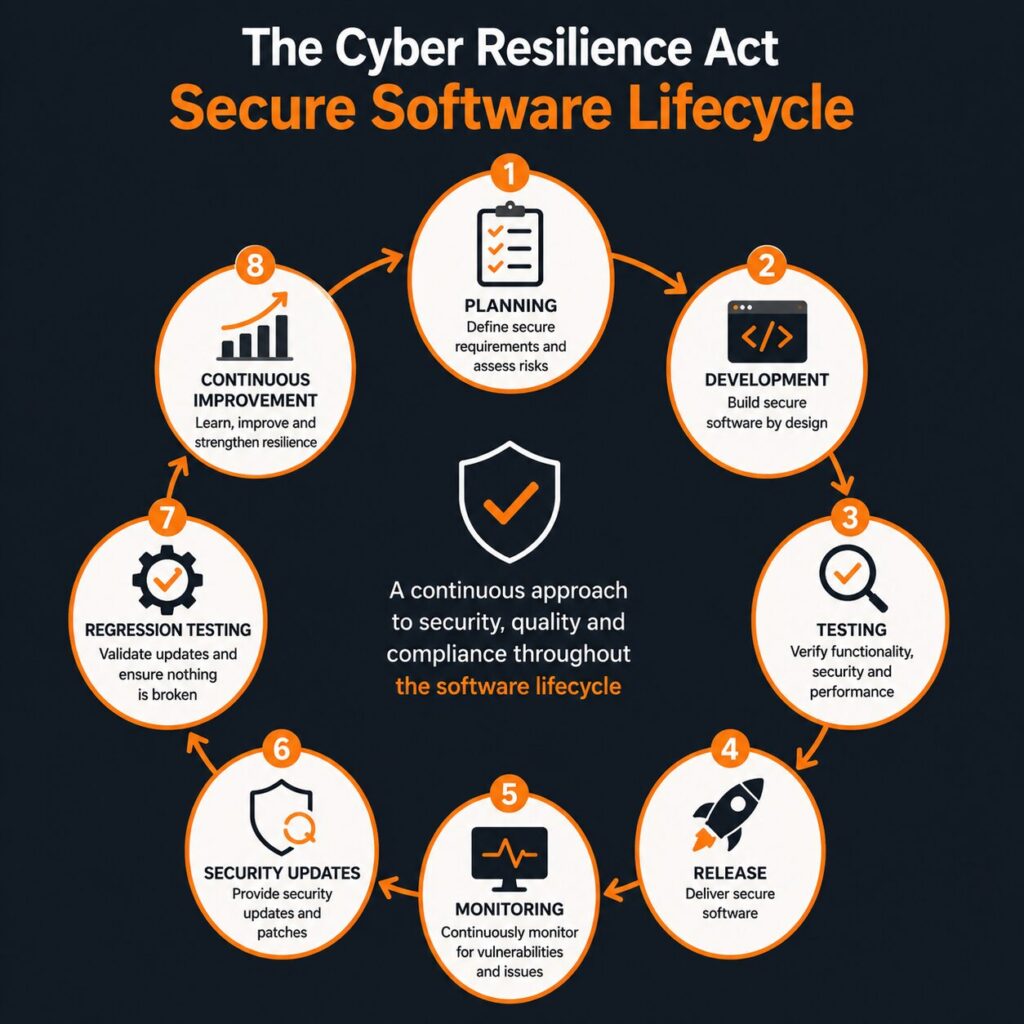
Unlike previous legislation that often focused on specific industries or individual cybersecurity practices, the Cyber Resilience Act takes a lifecycle approach. It encourages organisations to consider security from the initial stages of development through to ongoing maintenance, vulnerability management and software updates.
The aim is to improve the security and resilience of software throughout its operational life, helping organisations reduce cyber risks while giving customers greater confidence in the products they use.
Although the legislation is centred on cybersecurity, it also reinforces the importance of software quality. Every software update or security patch must continue to function as expected without introducing new issues, making effective testing an increasingly important part of the software development lifecycle.
Who Does the Cyber Resilience Act Apply To?
The Cyber Resilience Act applies to manufacturers, developers and suppliers of products with digital elements that are placed on the EU market. This includes a broad range of software products, applications and connected devices across both the public and private sectors.
Organisations that may be affected include:
- Software vendors and SaaS providers
- Enterprise software developers
- Manufacturers of connected devices and IoT products
- Industrial and manufacturing technology providers
- Healthcare technology companies
- Financial services software providers
- Organisations supplying software to government or defence sectors
Even organisations based outside the European Union may need to comply if they develop or supply software to customers within the EU.
For many businesses, the legislation represents more than a regulatory requirement. It reflects a growing expectation that software should be secure by design, regularly maintained and supported by robust quality assurance processes throughout its lifecycle.
Why Software Testing Is Becoming Part of Compliance
Historically, software testing has focused on identifying defects before applications are released. While that remains its primary purpose, evolving regulations such as the Cyber Resilience Act are increasing the importance of demonstrating that software continues to operate reliably throughout its lifecycle.
Modern software rarely stands still. Security patches, feature updates, operating system changes and third-party integrations all introduce the potential for unintended consequences. Without effective testing, even a small update can affect critical business processes or introduce new vulnerabilities.
This means organisations increasingly need confidence that software updates:
- Maintain existing functionality.
- Continue to meet business requirements.
- Perform consistently across supported platforms.
- Do not introduce unnecessary operational risk.
- Can be supported with documented testing evidence.
Secure, repeatable testing helps organisations reduce these risks while providing greater confidence in every software release.
Challenges Facing Modern Software Development
Meeting these expectations is becoming increasingly complex. Many organisations now support a diverse technology landscape that includes modern cloud applications alongside decades-old legacy systems.
Common challenges include:
- Frequent Software Releases
Agile development and continuous delivery have accelerated release cycles, leaving less time for manual validation. - Multiple Operating Systems
Applications often need to support Windows, macOS, Linux, web browsers, Android and iOS, significantly increasing testing requirements. - Legacy Applications
Many business-critical systems remain in operation for years or even decades. These applications often lack modern automation interfaces but still require ongoing testing whenever changes are introduced. - Highly Customised Environments
Enterprise software is frequently tailored to individual organisations, making standardised testing approaches more difficult. - Security-Conscious Infrastructure
Government, defence, finance and healthcare organisations may operate within tightly controlled or air-gapped environments where cloud-based testing solutions are not appropriate.
Together, these challenges make software testing more time-consuming and resource-intensive, increasing the need for scalable automation.
Why Manual Testing Is No Longer Enough
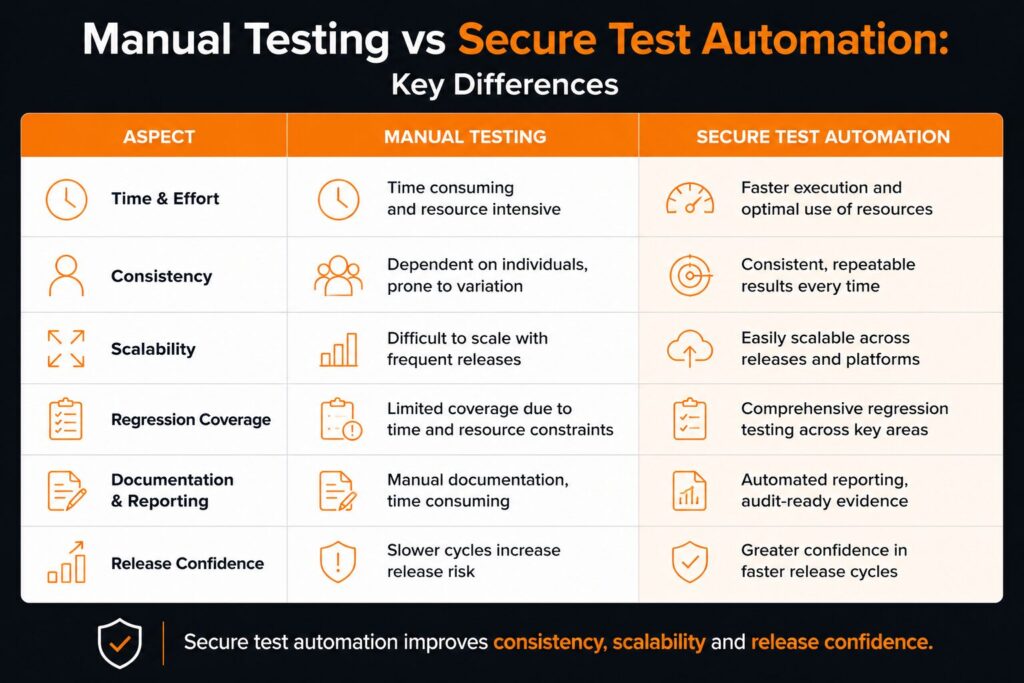
Manual testing remains valuable for exploratory testing and usability assessments, but it becomes increasingly difficult to rely on as the primary method of validating software.
Large regression test suites can take days to execute manually, making them difficult to repeat after every software update. Human error, inconsistent execution and limited resources can also reduce confidence in the results.
Automated testing addresses many of these challenges by enabling organisations to execute the same validation processes consistently, efficiently and whenever required.
Rather than replacing manual testers, automation allows testing teams to focus their expertise where it delivers the greatest value while repetitive regression testing is handled automatically.
What Is Secure Test Automation?
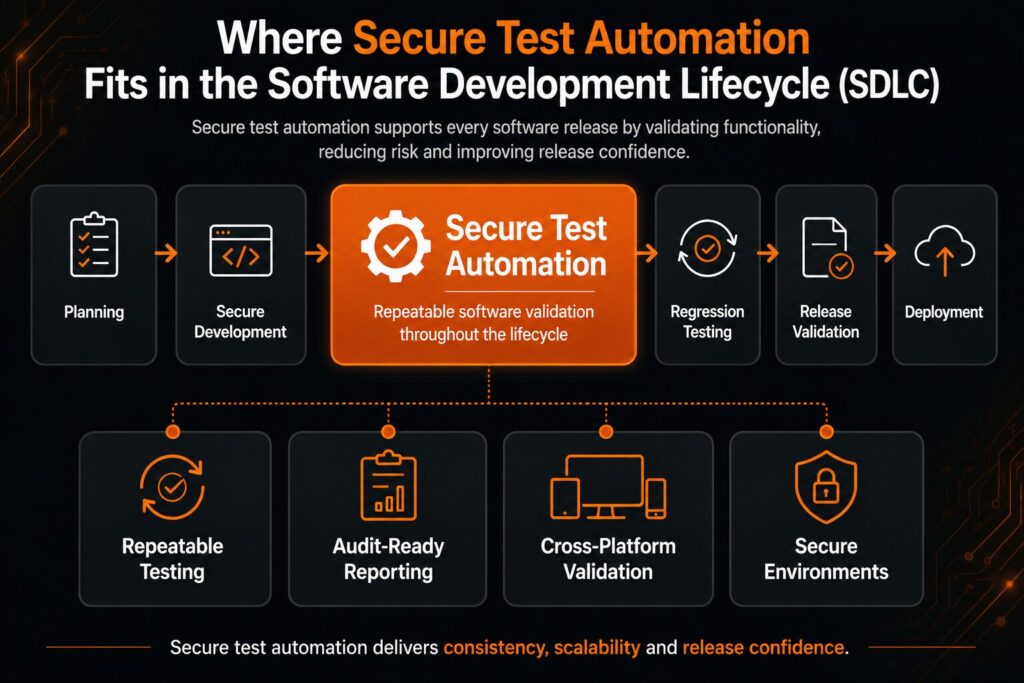
Secure test automation combines automated software testing with the security, governance and reliability required by organisations operating in regulated or security-conscious environments.
While every organisation’s requirements are different, secure test automation typically includes:
- Repeatable test execution.
- Reliable regression testing.
- Comprehensive test reporting.
- Audit-friendly documentation.
- Support for controlled deployment environments.
- Secure handling of test assets and data.
- Scalable execution across multiple platforms.
The goal is not simply to execute tests more quickly, but to provide confidence that software continues to function correctly as it evolves.
The Benefits of Secure Test Automation
- Repeatable Testing
Automation removes inconsistencies by executing the same test steps every time, providing reliable regression testing across multiple releases. - Faster Regression Testing
Automated test suites can validate critical workflows significantly faster than manual testing, enabling teams to release software with greater confidence. - Cross-Platform Validation
A single automated testing strategy can support applications running across Windows, Linux, macOS, mobile devices and virtual environments, reducing duplicated effort. - Improved Audit Readiness
Detailed execution logs and test reports help organisations demonstrate testing activities and maintain clear records throughout the software lifecycle. - Reduced Operational Risk
By identifying defects before deployment, automated testing reduces the likelihood of software updates disrupting business-critical operations.
Why Visual Test Automation Supports Secure Software Testing
Many automation tools rely heavily on application code, object identifiers or underlying frameworks. While these approaches are effective in many situations, they can become difficult to maintain across legacy systems or highly customised applications.
Visual UI automation interacts with software in the same way users do by recognising interface elements on the screen. This makes it particularly effective for environments where traditional automation may be difficult to implement.
Visual automation can help organisations test:
- Legacy desktop applications.
- Enterprise business systems.
- Virtual desktop environments.
- Remote applications.
- Cross-platform software.
- Applications without accessible source code.
This flexibility makes visual automation well suited to organisations managing diverse software estates.
Best Practices for Cyber Resilience Act Readiness
While every organisation’s compliance journey will differ, several best practices can help strengthen software quality and resilience.
- Automate Regression Testing
Ensure critical business processes are validated whenever software changes are introduced. - Test Across Supported Platforms
Verify consistent behaviour across operating systems, browsers and supported devices. - Maintain Testing Evidence
Retain reports and execution records to demonstrate testing activities where appropriate. - Include Legacy Applications
Avoid focusing solely on modern applications. Older systems often remain business critical and require ongoing validation. - Build Security Into The Development Lifecycle
Testing should support continuous software quality rather than becoming a final release-stage activity.
Common Mistakes Organisations Make
Several common challenges continue to affect software quality programmes:
- Relying solely on manual regression testing.
- Testing only new functionality while overlooking existing workflows.
- Ignoring desktop or legacy applications.
- Failing to validate software across supported operating systems.
- Treating testing as a one-off activity rather than an ongoing process.
- Lacking repeatable testing processes and documented evidence.
Addressing these issues early can improve both software quality and release confidence.
How T-Plan Supports Secure Test Automation
For more than 25 years, T-Plan has helped organisations automate testing across desktop, web and mobile applications, including many operating within highly regulated industries.
Our visual automation approach enables organisations to build repeatable, reliable testing processes across a wide range of technologies, including legacy systems, enterprise applications, virtual desktops and cross-platform environments.
Key capabilities include:
- Visual UI automation.
- Cross-platform testing.
- Desktop application automation.
- Legacy system support.
- Virtual desktop testing.
- Low-code and no-code automation.
- On-premise deployment options.
- Detailed reporting and repeatable execution.
Whether supporting digital transformation, modern software delivery or long-term application maintenance, secure test automation helps organisations improve software quality while reducing operational risk.
Ready to Strengthen Your Software Testing Strategy?
Whether you’re preparing for evolving regulations, modernising legacy applications or looking to improve software quality, secure test automation can help you build repeatable, reliable and scalable testing processes.
T-Plan enables organisations to automate testing across desktop, web and mobile applications, supporting secure environments, cross-platform validation and long-term software quality.
Cyber Resilience Act Compliance FAQs
The Cyber Resilience Act (CRA) is an EU regulation that introduces cybersecurity requirements for products with digital elements throughout their lifecycle, encouraging organisations to build and maintain secure software.
The legislation places significant emphasis on maintaining secure software throughout its lifecycle. Effective software testing helps organisations validate updates, reduce release risk and support overall software quality.
Secure test automation refers to automated testing practices designed to provide repeatable, reliable and well-governed software validation, particularly within regulated or security-conscious environments.
Automated testing enables organisations to execute consistent regression tests, identify defects earlier and validate software across multiple platforms, helping reduce operational risk.
Regression testing verifies that software updates, bug fixes or security patches have not introduced unintended issues into existing functionality.
Yes. Many legacy desktop applications and enterprise systems can be automated using visual UI testing techniques that interact with applications in the same way users do.
Secure test automation is particularly valuable for organisations operating within defence, government, healthcare, finance, manufacturing and other regulated industries where software reliability and governance are critical.
T-Plan provides visual UI test automation for desktop, web and mobile applications, helping organisations automate regression testing, improve software quality and support secure software delivery across modern and legacy environments.