A Complete Guide to Self-Healing Automation, Visual Validation and Reliable Regression Testing
Test automation environments are becoming increasingly dynamic. Applications change rapidly, UI elements evolve between releases and development teams are under constant pressure to reduce maintenance overhead.
To address this, many automation platforms now promote self-healing test automation as a solution to unstable tests and broken locators.
The promise is appealing.
Self-healing automation frameworks can automatically adapt to certain application changes, reducing script failures and minimising manual maintenance. In theory, this allows teams to spend less time fixing tests and more time delivering software.
However, self-healing automation also introduces new risks.
If implemented incorrectly, self-healing frameworks can mask genuine regressions, validate incorrect UI behaviour or silently adapt to application changes that should actually fail testing.
The challenge is no longer simply keeping tests running. The real challenge is ensuring that automation remains trustworthy, repeatable and capable of detecting real defects.
This guide explains how self-healing test automation works, where it delivers value, where it can become dangerous, and how teams can combine intelligent automation with reliable validation strategies.
What Is Self-Healing Test Automation?
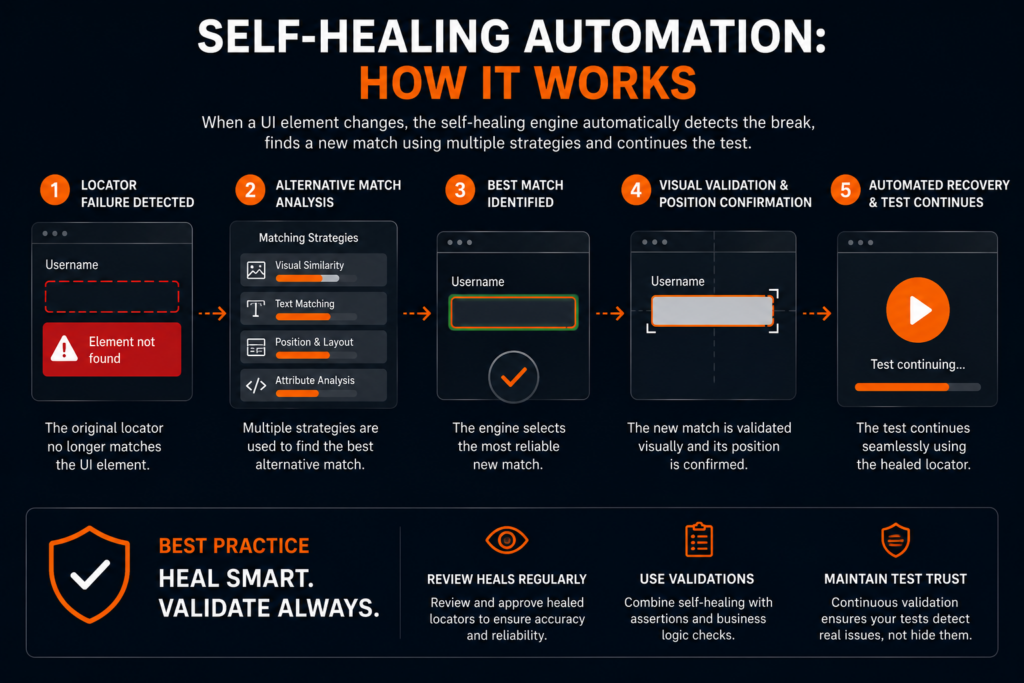
Self-healing test automation refers to automation frameworks that can automatically recover from certain test failures without manual intervention.
Most self-healing systems focus on repairing:
- broken locators
- changed UI elements
- modified object identifiers
- dynamic page structures
- unstable selectors
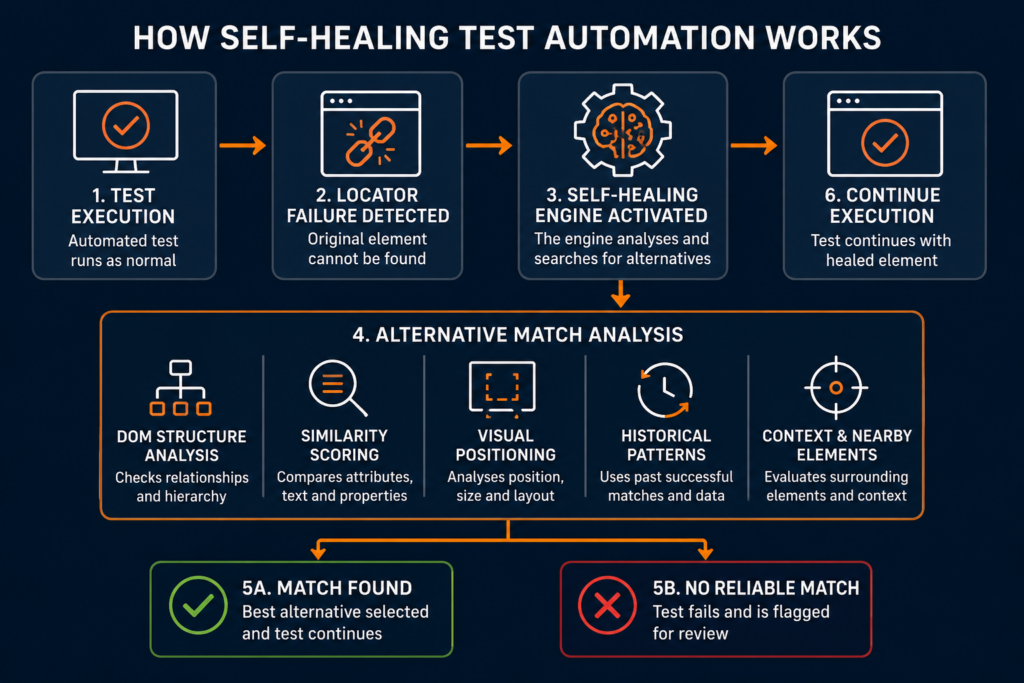
Instead of failing immediately when an element changes, the framework attempts to identify alternative matches based on:
- neighbouring elements
- historical patterns
- AI-driven matching
- similarity scoring
- DOM relationships
- visual positioning
This allows tests to continue executing even when the application structure changes slightly.
Why Self-Healing Automation Has Become Popular
Software is changing constantly.
Agile delivery, CI/CD pipelines and rapid UI updates can create large maintenance burdens for automation teams.
Traditional object-based automation frameworks often fail when:
- IDs change
- CSS selectors are updated
- page layouts shift
- component frameworks evolve
- dynamic rendering is introduced
As a result, teams spend significant time maintaining automation scripts instead of validating software quality.
Self-healing frameworks attempt to reduce this maintenance overhead by adapting automatically to minor application changes.
This can improve:
- automation stability
- execution continuity
- regression coverage
- maintenance efficiency
- pipeline resilience
For large automation environments, these benefits can be substantial.
How Self-Healing Test Automation Works
Different frameworks implement self-healing in different ways, but most approaches rely on pattern matching and fallback logic.
Common approaches include:
Locator-Based Healing
The framework attempts to identify alternative selectors when the original locator fails.
This may include:
- XPath similarity
- CSS pattern matching
- DOM hierarchy analysis
- attribute comparison
- neighbouring element relationships
AI-Assisted Healing
Some platforms use machine learning models to predict likely replacement elements based on historical behaviour and usage patterns.
These systems may analyse:
- previous successful executions
- UI positioning
- label similarity
- page structure
- interaction history
Visual Matching
Visual automation platforms can compare screen appearance rather than relying entirely on underlying DOM structure.
This allows automation to identify:
- moved UI elements
- redesigned interfaces
- rendered desktop applications
- remote desktop environments
- virtualised systems
Visual approaches can provide additional resilience where object identifiers are unstable or unavailable.
The Benefits of Self-Healing Test Automation
Reduced Maintenance Overhead
One of the biggest advantages is reduced script maintenance.
Minor UI changes no longer automatically break entire regression suites.
This allows teams to:
- maintain execution continuity
- reduce manual locator updates
- improve delivery speed
- stabilise CI/CD pipelines
Improved Automation Stability
Self-healing frameworks can reduce false failures caused by non-functional UI changes.
This helps teams focus on genuine defects rather than repetitive maintenance tasks.
Faster Regression Execution
By automatically adapting to small changes, teams can execute regression suites more consistently across frequent releases.
Better Support for Dynamic Applications
Modern applications increasingly use:
- dynamic rendering
- component-based architectures
- responsive layouts
- frequently changing front ends
Self-healing logic can improve automation resilience in these environments.
The Hidden Risks of Self-Healing Automation
Despite the benefits, self-healing automation introduces serious risks if not carefully controlled.
1. Masked Regressions
This is the biggest concern.
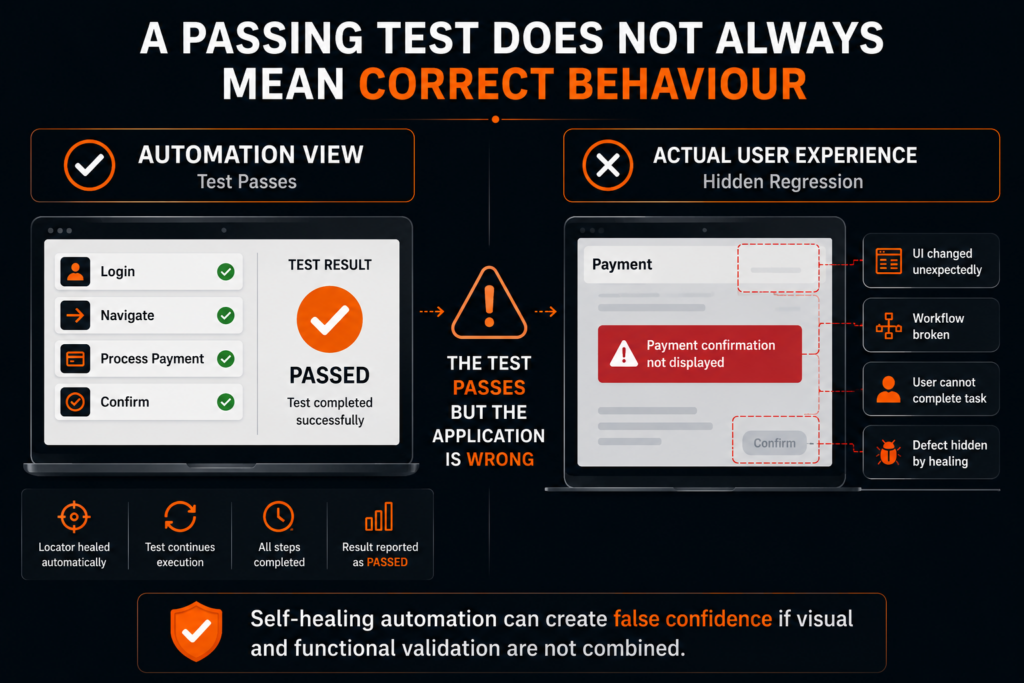
A framework may automatically adapt to a changed element that actually represents a defect.
For example:
- a button moves unexpectedly
- a label changes incorrectly
- a workflow is broken
- a UI state becomes invalid
Instead of failing, the automation silently adapts and continues.
The test passes even though the user experience is degraded.
This creates false confidence and reduces trust in automation.
2. Incorrect Element Matching
Self-healing systems may identify the wrong replacement element.
This can lead to:
- incorrect interactions
- invalid assertions
- hidden workflow failures
- inaccurate test results
The more aggressive the healing logic becomes, the higher the risk of incorrect matching.
3. Reduced Visibility Into Application Changes
If frameworks constantly adapt automatically, teams may lose visibility into:
- UI instability
- architectural drift
- frontend inconsistencies
- growing technical debt
Some failures should remain visible.
4. Over-Reliance on AI Decisions
AI-assisted healing introduces probabilistic behaviour into testing.
This can reduce predictability and repeatability if healing decisions are not carefully reviewed and controlled.
Reliable automation should remain deterministic wherever possible.
Locator-Based vs Image-Based Self-Healing
Traditional self-healing frameworks rely heavily on:
- DOM structure
- attributes
- XPath relationships
- CSS selectors
Advantages
- fast execution
- lightweight implementation
- browser-native interaction
Limitations
- vulnerable to frontend changes
- dependent on application structure
- difficult in remote environments
- limited support for desktop applications
Image-Based & Visual Self-Healing
Visual automation approaches validate what the user actually sees rather than relying entirely on underlying code structure.
Advantages
- resilient to DOM changes
- supports desktop applications
- works in remote environments
- useful for Citrix and virtual desktops
- validates real UI appearance
Limitations
- requires strong baseline management
- sensitive to rendering inconsistencies
- may require visual tuning
For many enterprise environments, combining object-based and visual validation produces the most reliable results.
How to Avoid Masked Regressions
Self-healing automation should never operate without guardrails.
The goal is not simply keeping tests alive. The goal is maintaining trusted validation.
Use Visual Validation Layers
Visual validation helps confirm:
- layout integrity
- correct UI states
- workflow consistency
- rendering accuracy
- user-visible behaviour
This creates an important safety net when locator healing occurs.
Require Review for Healed Actions
Automation frameworks should log:
- healed locators
- matching confidence
- fallback decisions
- UI changes detected
Teams should review healing activity regularly rather than allowing silent adaptation indefinitely.
Maintain Baseline Comparisons
Baseline validation helps teams detect:
- unexpected UI drift
- structural inconsistencies
- rendering problems
- visual regressions
Without baselines, self-healing systems may slowly adapt to broken behaviour over time.
Limit Healing Scope
Not every element should self-heal automatically.
Critical workflows such as:
- payments
- authentication
- regulated processes
- healthcare workflows
- financial transactions
may require stricter validation controls.
Combine Functional and Visual Testing
Functional automation validates behaviour.
Visual automation validates presentation and user experience.
Together they create stronger regression protection.
When Self-Healing Automation Works Best
Self-healing automation is most effective when:
- UI changes are frequent but low risk
- frontend structures evolve regularly
- maintenance overhead is high
- applications are highly dynamic
- automation maturity is already established
It works less effectively when:
- applications are heavily regulated
- workflows are highly sensitive
- UI changes indicate serious defects
- deterministic validation is essential
Why Trust Still Matters More Than Automation Speed
Automation conversations increasingly focus on:
- AI-driven execution
- autonomous testing
- self-healing frameworks
- intelligent automation
These technologies can provide genuine value.
However, automation is only useful if teams trust the results.
A perfectly stable automation suite that silently ignores defects creates more risk than a smaller suite that consistently detects genuine problems.
The future of automation is unlikely to be fully autonomous.
Instead, successful teams will combine:
- intelligent automation
- human oversight
- visual validation
- controlled healing
- repeatable testing strategies
- cross-platform validation
How T-Plan Supports Reliable Automation Validation
T-Plan supports visual, cross-platform automation designed for complex enterprise environments.
T-Plan helps teams validate:
- desktop applications
- remote desktops
- virtual environments
- Citrix systems
- legacy applications
- cross-platform workflows
- visual UI consistency
By combining visual automation with repeatable validation strategies, organisations can reduce automation fragility while maintaining confidence in test results.
With over 25 years of automation experience, T-Plan helps organisations build reliable automation frameworks that prioritise trust, visibility and repeatability.
Self-Healing Test Automation FAQs
Self-healing test automation refers to frameworks that automatically recover from certain automation failures, such as broken locators or changed UI elements.
Yes. Poorly controlled self-healing systems can adapt to genuine regressions and allow tests to pass incorrectly.
Masked regressions occur when automation adapts to unexpected application changes instead of identifying them as failures.
Both approaches have strengths. Visual automation provides stronger UI validation, while locator-based automation often executes faster. Many organisations combine both methods.
Visual validation helps confirm that the user experience remains correct even when locator healing occurs behind the scenes.