A Guide to RPA in Insurance
Robotic Process Automation (RPA) in insurance is enabling organisations to streamline complex, high-volume processes without disrupting existing systems.
In this guide, we explore how RPA is used across the insurance industry, including key use cases, benefits and practical applications in areas such as claims processing, underwriting and compliance.
For insurers under pressure to improve efficiency while maintaining accuracy and regulatory standards, RPA offers a scalable and low-risk path to automation.
Why is RPA important in insurance?
Insurance operations are typically complex, high-volume and heavily regulated. Many processes remain manual, time-consuming and prone to error.
Many insurance organisations still rely on legacy and mainframe systems, making traditional integration complex and costly.
RPA addresses these challenges directly.
RPA is important in the insurance industry because it enables:
- Faster processing of high-volume transactions
- Greater consistency across systems and workflows
- Reduced operational overhead
- Improved compliance and auditability
- Scalable operations without increasing headcount
For insurers balancing efficiency, accuracy and regulatory pressure, RPA provides a practical and low-risk route to modernisation.
Benefits of RPA in insurance
The benefits of RPA in insurance are both immediate and long-term, delivering measurable improvements across operations.
Key benefits include:
- Improved speed and efficiency
Automate time-intensive tasks such as claims validation and policy updates - Greater accuracy and consistency
Reduce manual errors in data-heavy processes - Operational cost reduction
Lower administrative overheads through automation - Scalability
Handle peak demand without additional resource - Enhanced customer experience
Faster turnaround times and improved service reliability
RPA allows insurers to achieve these gains without the cost and disruption of replacing core systems.
How is RPA used in insurance?
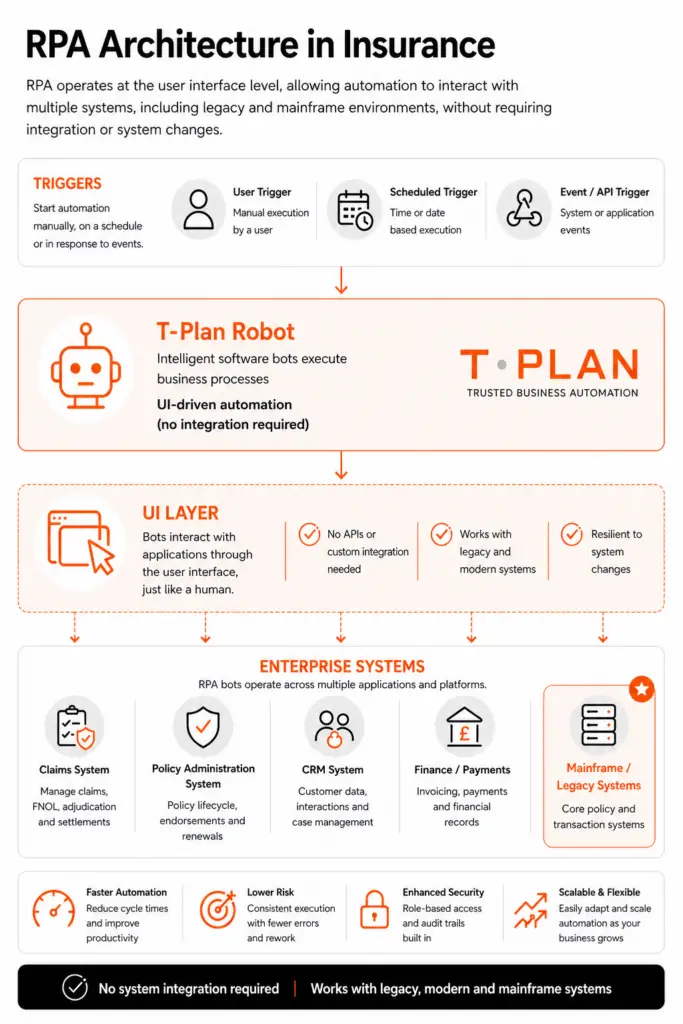
RPA operates at the user interface level, allowing automation to interact with multiple systems, including legacy and mainframe environments, without requiring integration or system changes.
Typical applications include:
- Claims processing
- Policy administration
- Underwriting support
- Customer onboarding
- Compliance and reporting
- Data validation and migration
The result is more streamlined workflows, improved data accuracy and reduced manual intervention.
RPA in insurance claims processing
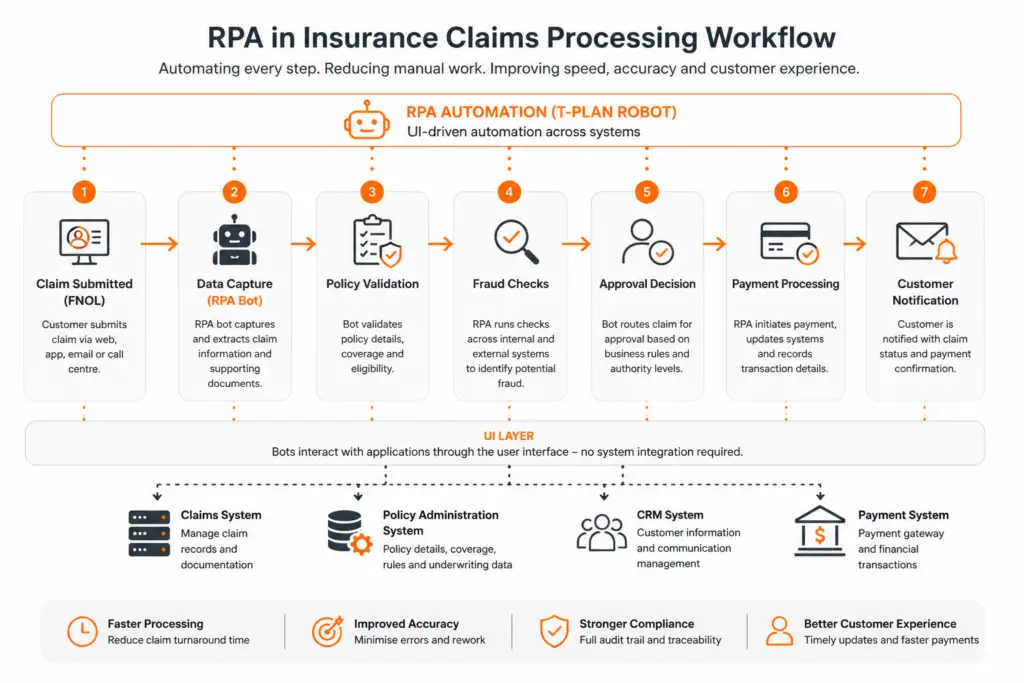
RPA streamlines insurance claims processing by automating each stage of the workflow, from initial data capture through to validation, decision-making and payment.
The diagram below illustrates how UI-driven automation reduces manual intervention while improving speed, accuracy and consistency across multiple systems.
RPA in insurance claims processing is one of the most impactful areas of adoption.
Claims handling often involves multiple systems, manual validation and high volumes of documentation, making it ideal for automation.
RPA can support:
- First Notice of Loss (FNOL) data capture
- Automated validation against policy rules
- Document classification and processing
- Fraud detection checks
- Payment processing
- Customer notifications
By automating these stages, insurers can significantly reduce processing times while improving accuracy and consistency.
RPA use cases in insurance
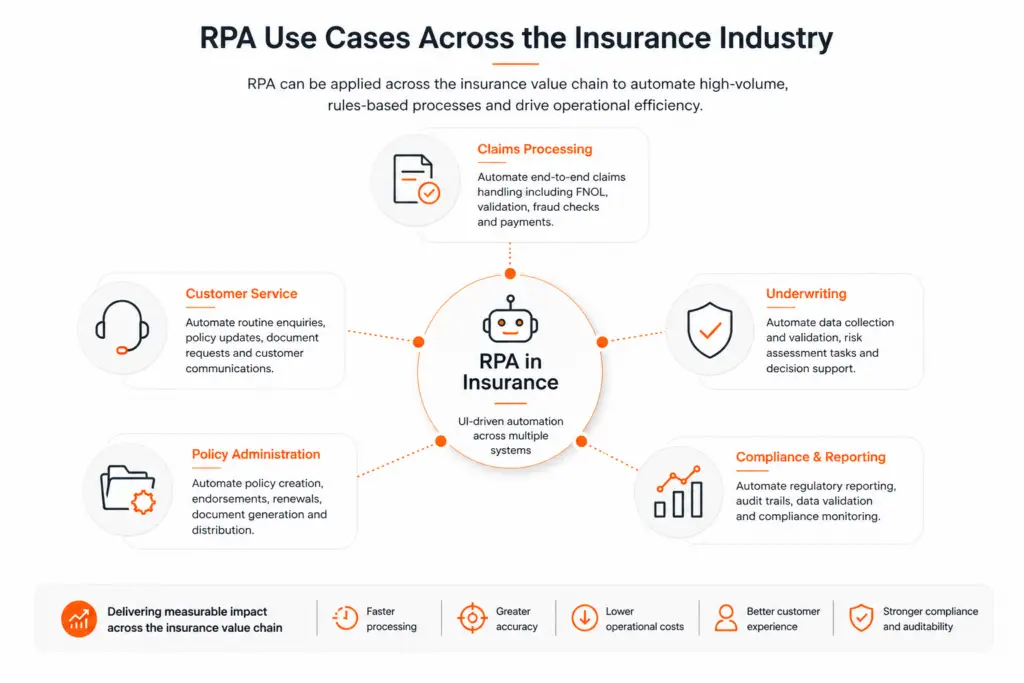
Claims management
- Automating data extraction and validation
- Triggering approvals and payments
Underwriting
- Aggregating and validating data from multiple sources
- Supporting risk assessment workflows
Policy administration
- Managing policy creation, updates and renewals
- Generating and distributing documentation
Customer service
- Handling routine queries and updates
- Supporting CRM workflows
Compliance and reporting
- Collecting and validating regulatory data
- Generating audit-ready reports
RPA in health insurance, life insurance and auto insurance
RPA can be applied across all major insurance sectors, with use cases tailored to each.
RPA in health insurance
- Claims adjudication and validation
- Patient data processing
- Billing and eligibility checks
RPA in life insurance
- Underwriting workflows and risk checks
- Identity verification (KYC)
- Claims processing
RPA in auto insurance industry
- Accident claims processing
- Policy renewals and updates
- Fraud detection workflows
While the processes differ, the objective remains consistent: reduce manual effort and improve operational efficiency.
RPA in the insurance industry: challenges and solutions
Many insurers face common operational challenges:
- Fragmented systems and data silos
- Manual data entry across multiple platforms
- Long processing cycles
- High operational costs
- Inconsistent customer experiences
Robotic process automation in the insurance industry addresses these challenges by introducing structured, repeatable automation across workflows, without requiring system replacement.
RPA in insurance case study (T-Plan perspective)
Automation in regulated environments requires precision, reliability and rapid deployment.
In a recent implementation, T-Plan supported a defence-sector organisation in automating testing for a critical public health application. The organisation required cross-platform consistency, fast implementation and strict compliance with security standards .
Key outcomes included:
- Rapid deployment with immediate operational impact
- Consistent automation across multiple platforms
- Reduced manual effort and improved reliability
- Strong alignment with compliance requirements
These outcomes closely reflect the needs of insurance organisations, particularly in areas such as claims processing, compliance and high-volume data handling.
The future of robotic process automation in Insurance
RPA is evolving beyond task automation into broader process optimisation.
Future developments include integration with:
- Artificial intelligence and machine learning
- Intelligent document processing
- Process mining tools
- End-to-end automation platforms
This shift enables insurers to move from isolated automation initiatives to fully optimised, data-driven operations.
Conclusion
RPA in the insurance sector provides a practical, scalable approach to improving efficiency, accuracy and service delivery.
From insurance claims processing to underwriting and compliance, RPA enables organisations to:
- Streamline complex workflows
- Reduce operational costs
- Improve consistency and accuracy
- Enhance customer experience
For insurers seeking to modernise without disrupting existing systems, robotic process automation in insurance offers a proven and effective solution.
Ready to streamline your insurance processes with RPA?
Speak to T-Plan about automating claims processing, policy administration and legacy systems—without complex integration.
RPA in Insurance: Implementation FAQs
Processes that are high-volume, rules-based and repeatable are ideal for RPA. This includes claims processing, policy administration, underwriting data validation and compliance reporting.
RPA reduces manual intervention by automating data capture, validation and decision workflows, allowing claims to be processed faster and more consistently.
Yes, RPA works at the user interface level, meaning it can interact with legacy systems without requiring integration or replacement.
RPA can operate within existing security frameworks, with full audit trails and controlled access, making it suitable for regulated industries such as insurance.
Traditional automation often requires system integration or development, whereas RPA mimics user actions at the interface level, enabling faster deployment with less disruption.