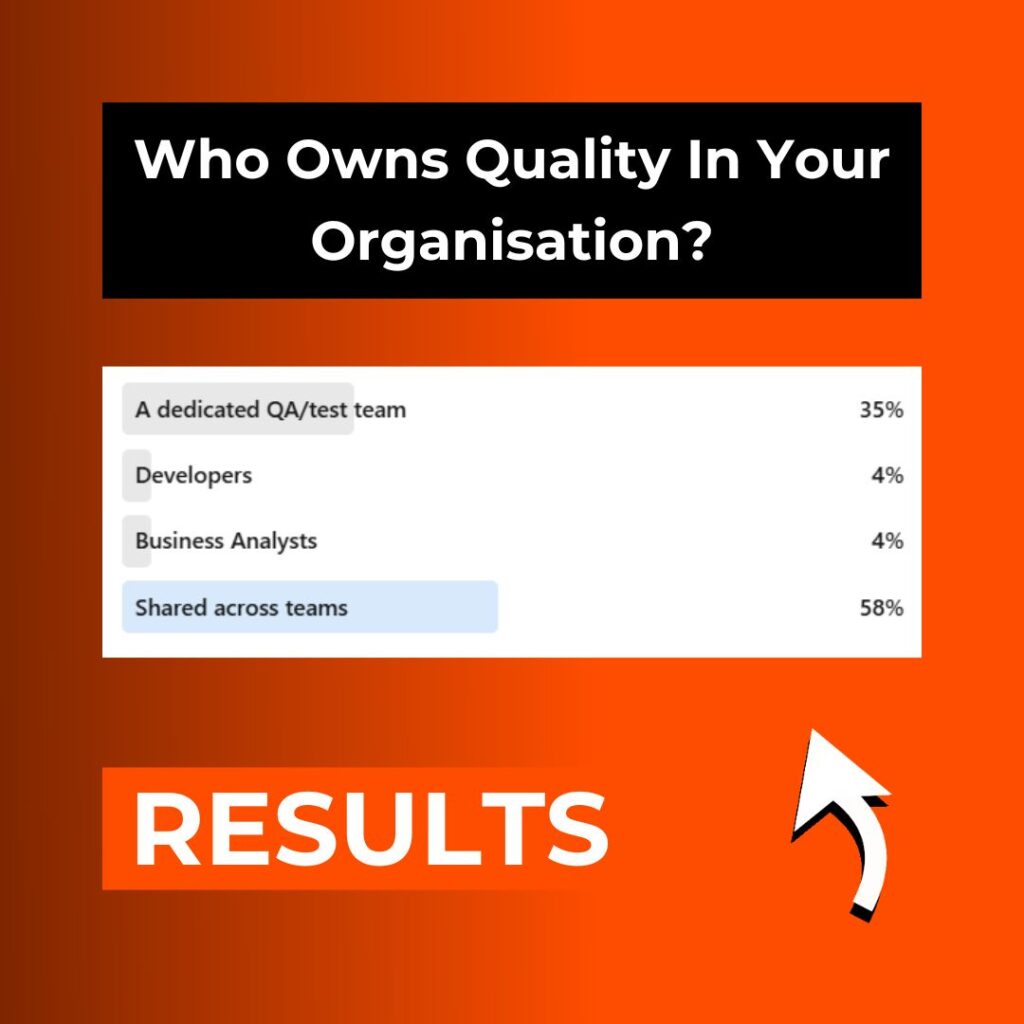
New poll results reveal a shift in quality ownership across software teams. Discover what this means for your QA strategy, test automation tools, and how your organisation can plan for better software quality and faster delivery.
The QA Ownership Poll: Understanding Quality in Modern Software Teams
As software delivery models evolve, organisations are re-examining a key question: who really owns software quality?
With the rise of agile development, shorter sprints, and continuous delivery, traditional boundaries around quality assurance (QA) are being blurred. To better understand where the industry stands, we ran a LinkedIn poll asking:
Who owns quality in your organisation today?
The testing community voted in one of the most popular polls to date and the results are in.
Results
| Team | Percentage of Votes |
| Shared across teams | 58% |
| Dedicated QA/test team | 35% |
| Developers | 4% |
| Business Analysts | 4% |
Key Stats & Insights:
- Shared Quality Ownership leads with 58%, reflecting a broader trend towards collaborative, cross-functional quality.
- 35% of organisations still rely on dedicated QA functions, indicating their ongoing importance in safeguarding reliability and compliance.
- Developers and business analysts each only received 4%, showing that quality is rarely viewed as the sole responsibility of one technical role.
Why Understanding QA Ownership Improves Software Delivery Speed
Clear, shared ownership of quality helps teams release software faster and with fewer issues.
When testing responsibilities are siloed or unclear, teams are more likely to:
- Delay testing until too late in the release cycle
- Encounter unexpected bugs and costly rework
- Prioritise speed over stability
By embedding test automation and shared accountability from the outset, teams can:
- Detect defects earlier
- Achieve faster feedback loops
- Deliver features more confidently and efficiently
Quality ownership is not just a process question, it’s a key factor in your delivery performance.
Strategic Insight: Why These Poll Results Matter for Business Planning
As organisations plan for growth and adapt to digital change, understanding how teams define ownership of quality is crucial.
Embedding quality into overall strategy helps you:
- Build realistic project timelines
- Allocate roles and responsibilities clearly
- Invest in appropriate test automation tools
- Align software delivery with customer expectations
- Improve cross-team collaboration
Departments that still rely solely on traditional QA functions may encounter inefficiencies or slow their digital delivery efforts. In contrast, shifting to cross-team ownership of quality supports innovation, agility, and alignment with modern delivery models.
What This Shift Means for the Testing Community and Business Stakeholders
The testing profession is changing. This shift in results shows that testers are now seen as:
- Quality leaders who influence delivery from start to finish
- Automation experts who enable better coverage and reliability
- Collaborators who work across development, product, and operations
For testers, it means expanding your skills in:
- Test automation frameworks
- CI/CD pipeline integration
- Quality coaching and feedback facilitation
For businesses, it validates the need to:
- Treat quality as a company-wide mindset, not just a team function
- Incentivise quality-driven behaviour at all stages of the SDLC
- Invest in tools and training that support cross-functional testing
Planning to scale? Make sure quality governance is included in your digital transformation roadmap.
Why T-Plan is the Ideal Test Automation Platform for Forward-Thinking Teams
If your business is shifting towards shared quality ownership, you need tools that support that goal. T-Plan.com offers a robust, flexible, and intuitive test automation solution that empowers teams to automate intelligently and collaborate effectively.
Key Benefits of Using T-Plan:
- Intuitive Interface: Low-code/no-code designer. Enables both testers and business users to design automated test cases with ease.
- Repeatable Test Execution: Record once, replay many times. Ideal for regression, smoke and system testing.
- Cross-platform from day one: Test on Windows, macOS, Linux, iOS, Android with a single script.
- Image-Based Testing: Uses OCR and image recognition for UI validations. Exactly how your users experience the product.
- CI/CD Ready: Seamless integration with Jenkins, Bamboo, Azure DevOps and other pipeline tools.
- Quick Deployment: Set up tests rapidly without major infrastructure changes or delays.
- Secure and Scalable: Encrypted batch execution, network deployment and compliance-friendly architecture.
- Secure and Scalable: Encrypted batch execution, network deployment and compliance-friendly architecture.
T-Plan is built for teams who value efficiency, traceability, and enterprise-grade test coverage.
Looking Ahead: Redefining QA Strategy for Your Organisation
Our poll shows the industry is heading towards a quality-first, team-owned model. The implications are clear:
- Testers play a broader role in coaching, strategy and automation.
- Businesses must plan with shared quality ownership in mind.
- Intelligent test automation platforms like T-Plan are essential to scale effectively.
Tell Us What You’re Seeing
We want your input. Are QA responsibilities shifting in your organisation? Are you seeing clearer ownership, or more confusion?
Read the last blog Is QA Shrinking? Who Owns Quality Now, And Does Anyone Still Care?
Let’s build a clearer, more accountable future for quality, together.
Contact Us