How to Build SAP Automation That Stays Reliable Over Time
SAP test automation is now a critical part of quality assurance for organisations running SAP ERP, SAP S/4HANA and SAP Fiori environments. Yet many teams still struggle to turn automation into lasting value. Tests become difficult to maintain, software upgrades introduce unexpected failures and growing enterprise environments increase the complexity of regression testing.
The challenge is rarely automation itself. More often, it is the way the automation strategy is designed and maintained.
Many organisations focus on creating automated tests as quickly as possible. Far fewer consider whether those tests will remain reliable six months, a year or even several years later. As SAP environments evolve, the cost of maintaining poorly designed automation can quickly outweigh the benefits it was intended to deliver.
This guide explores why SAP test automation projects lose value over time and how to build enterprise automation that stays resilient, maintainable and valuable as applications continue to change.
Why SAP Test Automation Often Starts Well
Most SAP automation projects begin with optimism.
A new automation framework is introduced, repetitive manual tests are replaced, and the first regression suites are delivered quickly. Testing teams begin to see immediate improvements in speed, consistency and release confidence.
At this stage, automation appears to be delivering exactly what the business expected.
The challenge is that these early successes often hide problems that only become visible over time.
As applications evolve, new functionality is introduced and user interfaces change, automation becomes increasingly expensive to maintain. Tests that once executed reliably begin to fail for reasons unrelated to software quality. Teams spend more time repairing automation than expanding it.
The automation itself becomes another system that requires ongoing maintenance.
This is the point at which many organisations begin questioning whether their investment is delivering the expected return.
The Real Reason SAP Test Automation Fails
It is tempting to blame SAP.
Enterprise applications are complex. User interfaces evolve. Business processes change. Upgrades introduce new functionality.
These are all genuine challenges.
However, they are rarely the real reason automation fails.
The more common problem is that automation has been designed to validate screens rather than the business process.
When automation depends heavily on object identifiers, application structure or complex scripting, even small interface changes can require significant rework. Maintenance effort increases with every release until automation becomes difficult to justify.
Successful SAP automation usually takes a different approach.
Rather than asking:
“How can we automate this screen?”
Organisations should ask:
“How can we create automation that remains reliable as this application changes?”
That shift in thinking often determines whether automation becomes a long-term business asset or an ongoing maintenance burden.
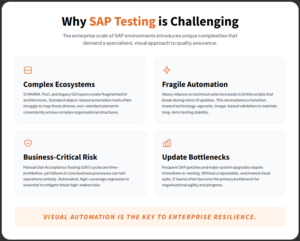
Why SAP Testing is Challenging
The enterprise scale of SAP environments introduces unique complexities that demand a specialised, visual approach to quality assurance.
Complex Ecosystems
S/4HANA, Fiori, and legacy GUI layers create fragmented UI architectures. Standard object-based automation tools often struggle to map these diverse, non-standard elements consistently across complex organisational structures.
Fragile Automation
Heavy reliance on technical selectors leads to brittle scripts that break during minor UI updates. This necessitates a transition toward technology-agnostic, image-based validation to maintain long-term testing stability.
Business-Critical Risk
Manual User Acceptance Testing (UAT) cycles are time-prohibitive, yet failures in core business processes can halt operations entirely. Automated, high-coverage regression is essential to mitigate these high-stakes risks.
Update Bottlenecks
Frequent SAP patches and major system upgrades require immediate re-testing. Without a repeatable, automated visual suite, IT teams often become the primary bottleneck for organisational agility and progress.
Visual Automation is the key to enterprise resilience.
Four Principles for Building Enterprise Tests That Last
Design for Change
- Applications change.
- Business processes evolve.
- User interfaces are redesigned.
- Successful automation anticipates change instead of assuming today’s interface will remain unchanged.
- Automation should be resilient enough to accommodate expected changes without major redevelopment after every release.
Validate the User Experience
- Users do not interact with object identifiers or application code.
- They interact with screens, workflows and business processes.
- Testing from the user’s perspective provides greater confidence that critical business functions continue to perform correctly while reducing dependence on the underlying application structure.
Reduce Maintenance Before Expanding Coverage
- Many organisations measure success by the number of automated tests they create.
- A better measure is how much effort those tests require to maintain.
- A smaller suite of reliable, maintainable tests often delivers more long-term value than thousands of fragile scripts.
- Quality should always take priority over quantity.
Treat Automation as a Long-Term Investment
- Automation is not a one-off project that finishes once the first regression suite has been delivered.
- It is an evolving capability that should continue supporting the business through upgrades, migrations and future development.
- Organisations that invest in maintainability from the beginning spend less time repairing automation and more time improving software quality.
Building SAP Test Automation That Lasts
Long-term success is not determined by how quickly automation is implemented, but by how well it adapts to change.
The most successful organisations focus on automation that supports business processes, remains resilient during software updates and minimises ongoing maintenance. They understand that sustainable automation is achieved through careful planning, maintainable design and continuous improvement rather than simply increasing the number of automated tests.
By adopting this approach, testing teams can reduce regression effort, improve release confidence and create SAP automation that continues to deliver value as enterprise applications evolve.
The Future of SAP Test Automation
SAP applications will continue to evolve.
Business requirements will continue to change.
Software updates will continue to introduce new challenges.
None of these should cause automation to fail.
The organisations that achieve the greatest return from SAP test automation are not necessarily those with the largest test suites. They are the organisations that design automation to withstand change from the outset.
Building enterprise tests that last is not about creating more automation.
It is about creating automation that remains reliable, maintainable and valuable throughout the lifetime of the application.
Ready to Build SAP Test Automation That Lasts?
Discover how T-Plan’s visual test automation software helps organisations reduce maintenance, automate business-critical SAP workflows and create reliable enterprise tests that stand the test of time.