A Guide to Desktop Automation Testing
Desktop applications continue to play a critical role across enterprise environments, from financial systems and insurance platforms to defence and public sector software. Many of these applications are business-critical, highly complex and often built on legacy frameworks that are difficult to modernise.
When it comes to testing, desktop environments present a unique challenge.
Unlike web applications, desktop software rarely provides easy access to underlying code structures, APIs or DOM elements. As a result, traditional automation approaches can fall short, leaving teams reliant on manual testing processes that are time-consuming, difficult to scale and prone to human error.
For organisations operating under tight deadlines, strict compliance requirements or cross-platform demands, this creates a significant risk.
QA teams are now rethinking how desktop applications are tested, moving towards more flexible and scalable approaches that do not rely on code-level access.
In this guide, we explore how automated testing for desktop applications works, the challenges involved and how teams can adopt a more resilient, future-ready approach.
What is Desktop Application Test Automation?
Desktop application test automation is the process of using software tools to execute tests on desktop-based applications automatically, without manual intervention.
These tests validate that an application behaves as expected across different scenarios, environments and user interactions, helping teams ensure quality, stability and performance throughout the development lifecycle.
There are several approaches to automating desktop applications:
- Code-Based Automation
This approach relies on direct access to the application’s underlying code or APIs. While powerful, it is often impractical for legacy systems or third-party applications where source code is unavailable. - Object Recognition-Based Automation
Some tools interact with applications by identifying UI elements such as buttons, fields and menus. However, these approaches can be brittle, as small UI changes or updates can cause tests to fail unexpectedly. - Visual (UI-Level) Automation
Visual automation interacts with the application in the same way a user would, through the graphical interface. By recognising elements on screen rather than relying on underlying code, this approach enables testing across virtually any desktop environment, including legacy and restricted systems.
This method is increasingly adopted by organisations that require flexibility, speed and resilience in their automation strategy.
Why Desktop Application Testing is Challenging
Automating desktop applications is fundamentally different from testing web or mobile platforms. Many of the tools and techniques that work effectively in browser-based environments do not translate to desktop systems.
- Limited Access to Application Internals
Desktop software often does not expose a DOM or accessible object model, making it difficult for traditional automation tools to reliably identify and interact with UI elements. - Legacy Systems and Technical Debt
Many organisations still depend on legacy desktop applications that have evolved over years or decades. These systems are rarely designed with automation in mind. - Cross-Platform Complexity
Applications often need to function across Windows, macOS and Linux environments. Ensuring consistent performance across each platform increases testing complexity significantly. - Security and Compliance Constraints
In regulated sectors, access restrictions and security policies can limit the use of intrusive testing tools, making automation more difficult to implement.
Approaches to Automating Desktop Applications
Choosing the right automation approach is critical for long-term success.
- Traditional Code-Based Tools
These tools rely on internal application access. While effective in controlled environments, they struggle with third-party software, legacy systems and restricted environments. - UI Object-Based Tools
Object recognition tools attempt to identify elements within the interface. However, they are often fragile and require ongoing maintenance when interfaces change. - Visual Automation (Recommended Approach)
Visual automation operates at the user interface level, interacting with applications based on what is visible on screen.
This approach offers several advantages:
- No dependency on source code or APIs
- Greater resilience to UI changes
- Compatibility with legacy and modern systems
- Cross-platform execution from a single script
For organisations managing complex desktop environments, visual automation provides a more stable and scalable solution.
Key Benefits of Desktop Test Automation
Implementing desktop automation delivers measurable improvements across quality, efficiency and scalability.
- Faster Testing Cycles
Automated tests can be executed repeatedly and consistently, significantly reducing regression testing time. - Reduced Manual Effort
Teams can focus on higher-value testing activities while automation handles repetitive tasks. - Improved Accuracy and Reliability
Automation eliminates human error and ensures consistent execution across all test runs. - Cross-Platform Consistency
Tests can be executed across multiple operating systems, ensuring consistent behaviour across environments. - Scalable Testing Strategy
Automation allows organisations to scale testing efforts without a proportional increase in resources.
Real-World Example: Automating a Critical Desktop Application in a High-Security Environment
A leading defence organisation required a robust automation solution to support a critical public health application. The system needed to operate seamlessly across multiple platforms, including Windows, macOS and Linux, while meeting strict security and compliance requirements.
Manual testing approaches were too slow and resource-intensive to meet deployment timelines. The organisation required a solution that could be implemented quickly and scale across environments.
By adopting T-Plan’s visual automation approach, the team achieved:
- Rapid deployment, with tests up and running in minutes
- Cross-platform test execution from a single script
- Improved accuracy and early detection of UI issues
- Reduced reliance on manual testing processes
The result was a faster, more reliable testing process that met the organisation’s strict operational and security requirements.
Best Practices for Desktop Application Test Automation
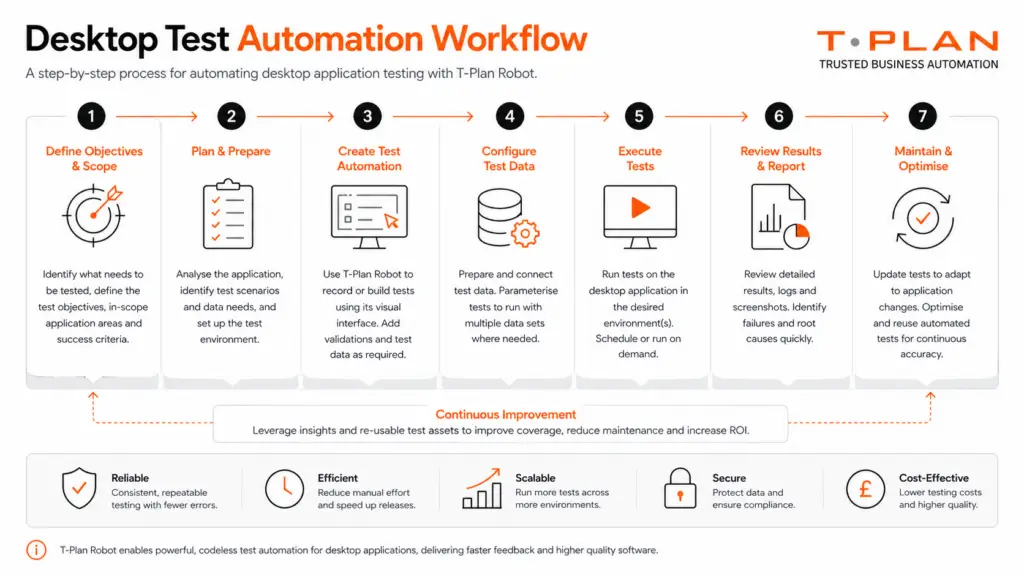
To maximise the value of automation, organisations should follow a structured approach:
- Prioritise high-impact test scenarios such as regression and critical workflows
- Use UI-level automation for legacy or restricted systems
- Design tests to be reusable and maintainable
- Ensure cross-platform compatibility from the outset
- Continuously review and optimise test coverage
Choosing the Right Desktop Automation Tool
When selecting an automation solution, consider the following criteria:
- Ability to operate without source code access
- Support for multiple operating systems
- Compatibility with legacy applications
- Ease of use and rapid onboarding
- Scalability and long-term maintainability
A solution that meets these requirements will provide greater flexibility and a stronger return on investment over time.
Conclusion
Automated testing for desktop applications is no longer optional for organisations that rely on complex, business-critical systems. As environments become more diverse and development cycles accelerate, manual testing alone cannot keep pace.
By adopting a flexible, UI-level approach to automation, organisations can overcome the limitations of traditional tools and build a more resilient testing strategy.
T-Plan enables teams to automate desktop applications quickly, reliably and at scale, without the need for intrusive access or complex integrations. For organisations working with legacy systems, cross-platform environments or regulated industries, this provides a clear and practical path forward.
Automated Testing for Desktop Applications: FAQS
Yes. Visual automation enables testing directly at the user interface level, removing the need for access to source code or APIs.
UI-level or visual automation is typically the most effective approach, as it does not rely on internal application structures.
Desktop automation can be more complex due to the lack of standardised interfaces. However, modern visual automation tools simplify this process significantly.
Yes. With the right tool, a single test script can be executed across Windows, macOS and Linux environments.
Implementation time varies, but modern tools can enable teams to start building and running tests within hours rather than days.