
























Robotic Process Automation (RPA) in Healthcare

  • Automate high-volume admin workflows – referrals, onboarding, billing and updates
  • Reduce manual errors and rework with consistent, rules-based execution
  • Deploy securely in controlled environments including on-prem and restricted networks
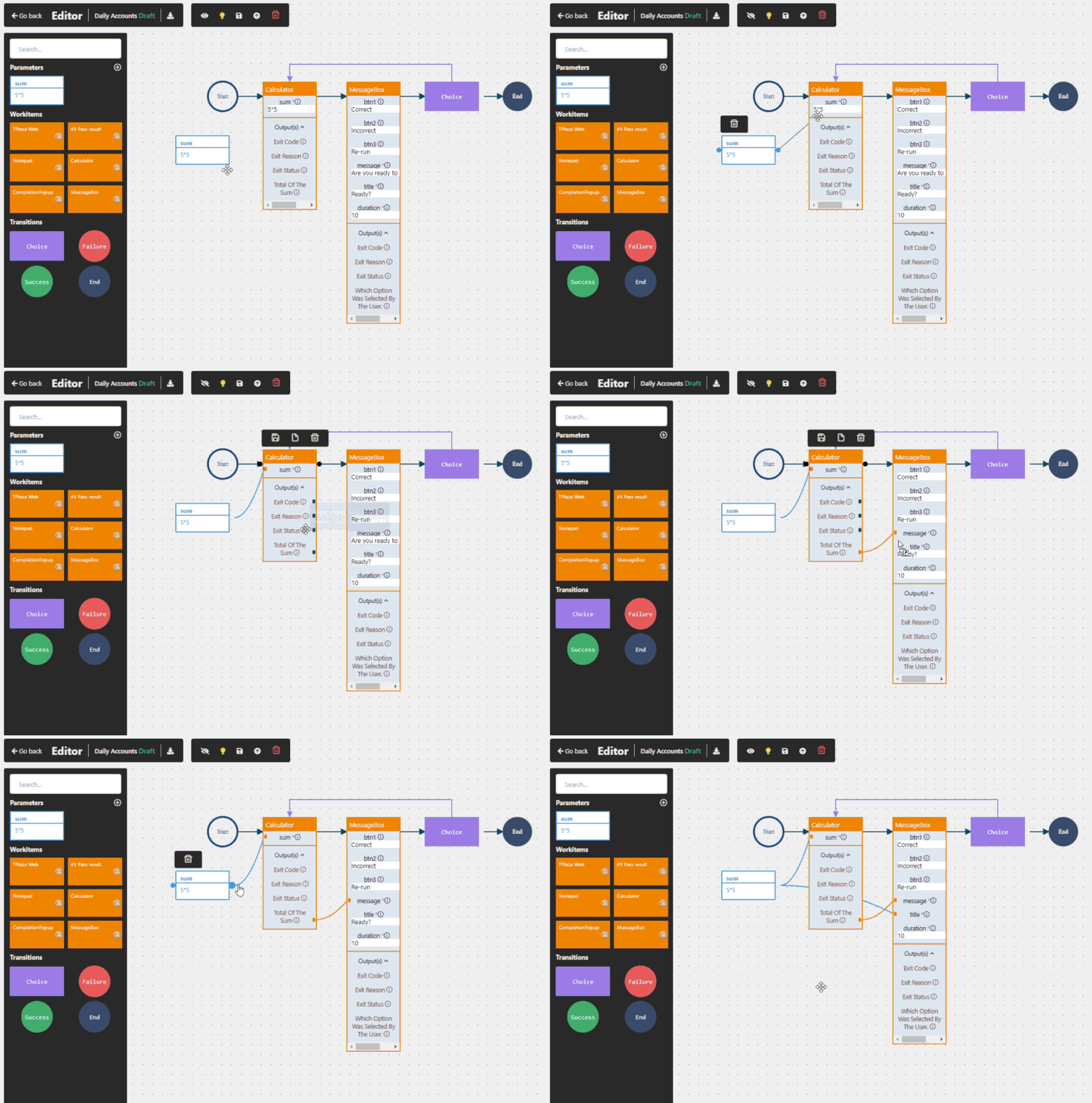
Demonstration of T-Plan
T-Plan in Action

Experience and Reliability at the Heart of Healthcare RPA

Healthcare environments demand secure, reliable automation that supports both compliance and operational efficiency. Robotic process automation in healthcare reduces repetitive administrative workload, improves consistency and strengthens control across critical systems. The result is streamlined workflows, improved accuracy and scalable automation designed for regulated healthcare settings.

Any device or
system

Built on Java our tool is environment and system agnostic, connecting all Healthcare solutions

Intuitive Visual
Testing Tool

Automated testing of software and workflows at user level, mimicking the work that a human being would do

No code access
required

T-Plan Robot does not require any internal modification to the system or application under test, making it usable for everyone

Improved Accuracy,
Lower Costs

Automate repetitive tasks, improve accuracy and maximise efficiency

Why Choose T-Plan For Robotic Process Automation in Healthcare

Healthcare environments demand automation that is secure, reliable and capable of operating across complex systems. T-Plan delivers robotic process automation in healthcare that works non-invasively, integrates across legacy and modern platforms, and scales safely within regulated infrastructures.

  • Non-invasive automation
    Run automation without altering healthcare systems, patient records or clinical applications.
  • Cross-platform compatibility
    Automate workflows across desktop applications, web portals and internal healthcare systems.
  • Automated document processing
    Capture and validate data from forms, PDFs and portals to streamline administrative processes.
  • Secure, controlled deployment
    Operate on-premise or within restricted networks where compliance and data protection are essential.
  • Scalable licensing model
    Expand automation across departments without complex infrastructure changes.

Why Use Robotic Process Automation?


Healthcare providers face increasing administrative pressure, compliance requirements and rising operational costs. Robotic process automation in healthcare enables organisations to automate repetitive, rules-based tasks while improving consistency and auditability.

Key benefits of healthcare process automation include:

  • Reduced administrative burden by automating high-volume tasks such as patient onboarding, referrals and billing updates
  • Improved accuracy through consistent, rules-driven execution that reduces human error
  • Faster processing times for documents, data entry and system updates
  • Greater compliance support through repeatable and auditable workflows
  • Better resource allocation by freeing clinical and administrative teams to focus on higher-value activities
  • Scalable operations without increasing headcount

By automating healthcare processes securely and consistently, organisations can improve efficiency while maintaining the high standards required in clinical and regulated environments.

Secure Healthcare Robotic Automation That Supports Compliance

Healthcare organisations must automate processes without compromising certified systems, patient data or regulatory requirements. T-Plan’s robotic process automation operates non-invasively at the user interface level, meaning no agents, code changes or system alterations are required.

Unlike invasive automation tools that require software to be installed on the system under test, T-Plan interacts only through the graphical interface. This preserves system integrity while providing a clear, auditable record of automated actions.

The result is secure healthcare process automation that supports compliance, protects certified environments and maintains full operational transparency.

HIPAA

Protects privacy and safety of medical information in the USA.

GDPR

Ensures data protection for healthcare apps in the EU.

HL7

Global standards for healthcare data sharing and interoperability.

HITRUST

Guarantees customer data protection and compliance framework.

PIPEDA

Canadian law for data privacy requirements and protection.

FDA

Oversees safety and efficiency of drugs and medical devices.

ICD-10

International standard for disease classification and coding.

PPACA

Patient Protection and Affordable Care Act compliance protocols.

PHI

Secure management and encryption of Protected Health Information.

ARRA

American Recovery and Reinvestment Act technology requirements.

HITECH

Health Information Technology for Economic and Clinical Health Act.

NIST

National Institute of Standards and Technology security standards.

Navigating Complex Medical Device Validation

Healthcare and life sciences organisations face numerous challenges in maintaining compliance while fostering innovation. Here’s how T-Plan’s non-invasive solutions address the core hurdles of modern medical QA:

Adhering to Evolving Standards

Regulations like FDA 21 CFR Part 11 and IEC 62304 are constantly updated. Manual testing struggles to keep pace, creating significant compliance backlogs.

Modernising Computer System Validation (CSV)

Traditional paper-based validation is slow and error-prone. Automated non-invasive testing simplifies complex implementation processes for digital health.

Mitigating Risk in Software Testing

Ensuring thorough, non-invasive evaluation across the entire lifecycle without sacrificing system integrity or certification status is critical for safety.

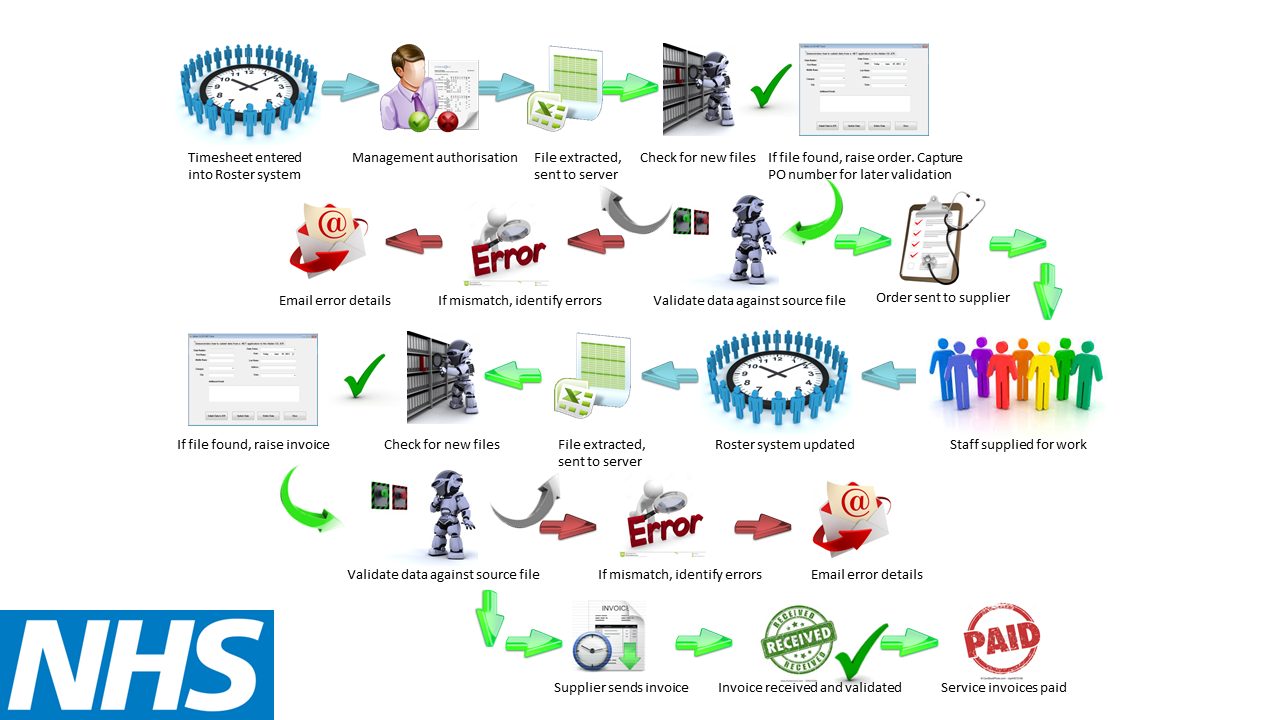
NHS Robotic Process Automation (RPA) Success Story: Case Study

T-Plan was tasked with automating the billing and reconciliation of nurses’ rostering systems for the Welsh National Health Service.

Our GUI robotic tools reduced time spent on manual tasks and improved data accuracy by 100% within just two months.

'What was a 6 hour process has been reduced down to just 10 mins. The results in saving time and money for the NHS have been obvious.'
NHS Logo
RPA
Project Manager

Trusted by Hundreds of Companies and Used by Thousands of People for Over 25 Years

Key Features of Our Healthcare Software Automation Tool

No-Code
Required

An intuitive drag-and-drop interface makes automation simple for technical and non-technical users alike.

Create Once, Repeat Anywhere

Define and reuse image-based tests across environments to support agile and continuous development.

Record and
Playback

Capture real user interactions and replay them across CAD platforms for consistent, visual validation.

External Data
Integration

Drive automation using live data from spreadsheets, databases, PDFs, or APIs for realistic CAD test scenarios.

Screen-Level
Automation

Test directly at the visual layer, replicating end-user actions and ensuring accurate, interface-driven results.

Multi-Platform
Support

Automate across Windows, macOS, and Linux — plus mobile and virtual environments — all from a single platform.

Image-Based for True End-User Simulation

Execute tests exactly as users experience them, visually confirming accuracy within CAD and design interfaces.

Third-Party
Integrations

Integrate seamlessly with Jenkins CI/CD pipelines and other tools to streamline build, test, and release workflows

An Authentically “Agnostic” Tool for the Healthcare Sector

Does your organisation work via different systems? Some legacy, some new?

No problem. T-Plan Robot can literally automate anything, anywhere.

As it operates across numerous applications and platforms, it’s truly system agnostic. Plus, it can test on mobiles and desktop environments.

Using Java, your testers can deploy Robot with Windows, Mac, Linux, Unix, Solaris and so on. Get in touch with T-Plan to find out more.

Further, whether you operate Chrome, Internet Explorer, Firefox or any other browser, Robot works perfectly on all of them.

Step Forward T-Plan Robot – A User-Friendly Guide

T-Plan Robot is an “image-based” tool that works at user level, operating as a human being would in a testing environment. Is the software fit for purpose? Does it, at a basic level, work “properly”? With Robot, your testing team will know.

  • Choose the testing scenario you need to automate, then T-Plan Robot will record and repeat it as often as you need – and tweak if necessary.
  • Create execution schedules as well as workflow rules; pass custom parameters for intelligent decision handling.
  • You can even build appropriate tests into long-term software development projects. And, test for scalability, too.
  • Use the Command Line to interact remotely with your test environment. You can integrate Robot into your existing frameworks and toolsets using the built-in CLI capability.

    With no need for modification to the system or application under automation, there’s no “intrusion” necessary. Robot spots and reports on bugs from the “outside”.

T-Plan’s Test Anything, Anywhere Automation Software for the Healthcare Sector

Robotic Process Automation in Healthcare FAQs

Robotic process automation in healthcare refers to the use of software bots to automate repetitive, rules-based digital tasks within healthcare systems. In the robotic process automation in Healthcare industry, these bots interact with applications through the user interface to complete tasks such as data entry, referral processing and document handling without modifying the underlying systems.

RPA is used to streamline administrative and operational workflows across hospitals, NHS trusts and private providers. Common examples of healthcare robotic process automation include automating patient onboarding, billing updates, referral management, appointment scheduling and reporting.

By automating healthcare processes, organisations reduce manual workload while improving accuracy and processing speed.

The benefits of robotic process automation in healthcare include:

  • Reduced administrative burden
  • Improved data accuracy and consistency
  • Faster processing of high-volume tasks
  • Enhanced auditability and compliance
  • Scalable healthcare process automation without increasing headcount

These advantages help healthcare providers improve operational efficiency while maintaining strict regulatory standards.

Robotic process automation RPA in healthcare can automate a wide range of structured workflows, including:

  • Patient registration and data validation
  • Claims and billing processing
  • Referral and discharge management
  • Automated document processing in healthcare
  • Reporting and compliance tracking

Platforms such as T-Plan enable non-invasive automation that works across legacy and modern healthcare systems.

Yes. When implemented correctly, robotic process automation in healthcare industry settings can operate within secure, controlled infrastructures. Non-invasive RPA solutions interact at screen level without altering certified healthcare systems, helping organisations preserve compliance and protect sensitive patient data.

Automated document processing in healthcare uses software to extract, validate and transfer information from forms, PDFs and digital records into clinical or administrative systems. Combined with robotic process automation in healthcare, it reduces manual data entry and improves accuracy across high-volume document workflows.

Yes. One of the advantages of process automation in healthcare is the ability to automate tasks across older desktop applications, web portals and internal systems.

Visual automation platforms such as T-Plan can operate through the graphical interface, making them suitable for legacy or closed systems where API access may be limited.

Book your FREE demo

Get in touch with our award-winning team today and unlock the power of our Automated Visual UI testing tool for your business.

Book your FREE demo

You’re just one step away from saving time & money – get in touch today.

  • No code access required
  • Visual UI testing tool
  • iOS and Mac compatible
  • All platforms supported
  • Mimics real time user experience
  • Record and playback function
  • Award winning support