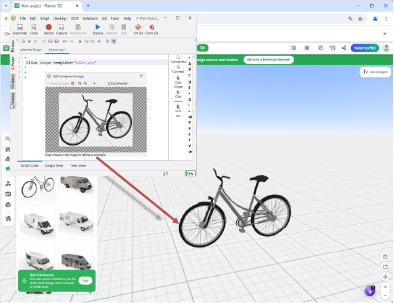
UI automation has evolved rapidly over the last year. The rise of AI assisted testing, the continued shift toward hybrid application architectures and growing pressure for cross platform coverage have all reshaped the automation landscape. With so much change, now is the ideal time to revisit the question many organisations are asking in 2026. What are the best UI automation tools available today, and which ones genuinely solve the challenges teams face when testing complex, mixed technology applications?
Last year we published a widely read comparison of UI and image based automation tools for 2025. That article brought transparency to a fragmented market, and its success showed that teams value balanced, evidence based analysis. This year we have taken a fresh look. Some tools remain strong contenders, others have shifted position, and a few new names have gained prominence, particularly in the AI enhanced visual testing space. The result is the following curated comparison of the tools that matter most in 2026.
Our approach is the same. Be fair, be pragmatic and provide a clear view of where each tool fits. The goal is not to tell every organisation that there is a single best tool for all situations. Instead, it is to help readers understand the strengths, limitations and ideal use cases of the leading options available today. That way you can make the right choice for your specific environment and ambitions.
How We Evaluated the Tools in 2026
To create a comparison that stands up to scrutiny, we assessed each tool against criteria that matter most to modern QA teams. These include:
- Automation style. Whether the tool uses image based, visual AI, DOM based or hybrid approaches.
- Platform coverage. Support for desktop, web, mobile, legacy or specialist graphical interfaces.
- AI capabilities. Whether the tool includes AI assisted healing, visual comparison or model based intelligence.
- Ease of use. Low code options, scripting flexibility and learning curve.
- Maintenance stability. How tools cope with UI change and the likelihood of false positives or negatives in visual tests.
- Deployment approach. Whether cloud, on premises or hybrid use is supported.
- Vendor stability. Business continuity, active development and long term roadmap health.
We also carried out checks on corporate status and product evolution throughout 2025 and into 2026. This included company activity, acquisitions, new releases and whether tools remained actively developed. This process revealed that while several long established players remain strong, some slow moving open source offerings are no longer evolving at the pace the market now demands. At the same time, a number of cloud native and AI centred visual tools have gained momentum.
The Top UI and Visual Automation Tools in 2026
Below is the updated set of tools that earn a place in this year’s comparison. These represent the most capable and relevant options for UI automation today.
1. T Plan
Visual and image based test automation across desktop, mobile, legacy and complex UIs
T Plan continues to stand out as one of the most versatile and dependable UI automation tools available. With more than twenty five years of continuous evolution, it remains one of the few platforms capable of delivering deterministic, repeatable, pixel driven UI automation across almost any technology. Its visual approach works directly on the rendered interface, which means it avoids the brittleness of DOM locators and can automate systems that other tools cannot reach, including CAD, industrial systems, financial terminals, defence applications and mixed technology stacks.
Strengths
- True image based automation supporting Windows, macOS, Linux, iOS and Android.
- Capable of automating legacy, custom, embedded and graphics heavy interfaces.
- Highly reliable and repeatable execution, which is essential for regulated environments.
- Low code and no code authoring options alongside powerful scripting for experts.
- On premises, secure and compliant deployment options.
- Strong UK based vendor stability and award winning technical support.
Limitations
- Not designed as a pure web only automation framework for teams who do not need visual validation.
Best for
Organisations that need dependable visual automation across heterogeneous estates or that require audit ready reproducibility. T Plan is particularly strong in defence, public sector, finance, healthcare and engineering environments.
2. Applitools
AI powered visual testing for web and mobile
Applitools remains one of the most popular AI visual validation tools. Its strength lies in comparing visual snapshots intelligently using machine learning to detect differences that matter. It integrates with common automation frameworks such as Selenium, Playwright and Cypress, making it a natural fit for teams already invested in code based testing.
Strengths
- Industry leading AI based visual comparisons.
- Wide integration support.
- Strong for web and mobile visual regression.
Limitations
- Requires additional frameworks for functional automation.
- Cloud based workflow may not be suitable for restricted environments.
Best for
Teams who need AI enhanced web and mobile visual testing and who already use standard browser automation frameworks.
3. Ranorex
Hybrid automation for desktop, web and mobile
Ranorex continues to be a widely adopted commercial tool. It offers a mature IDE and a broad feature set that combines element based automation with image recognition. It’s particularly useful in organisations that need one tool for desktop and web but prefer element driven testing where supported.
Strengths
- Mature, well supported and stable.
- Broad platform coverage including desktop and mobile.
- Combines DOM based and image based automation.
Limitations
- Higher licensing cost.
- More complex for beginners than low code tools.
Best for
Enterprise environments that want a long established vendor backed tool for mixed platform testing.
4. Eggplant Functional (Keysight)
Enterprise grade image based and AI driven testing
Eggplant remains a major competitor in the image based testing space. Under Keysight, the product has continued to evolve with strong AI modelling capabilities and cross device automation. It’s widely used in enterprise and performance heavy environments.
Strengths
- Image based any device, any platform approach.
- AI driven exploratory and model based testing features.
- Suitable for large scale and complex delivery pipelines.
Limitations
- Proprietary scripting language that some teams find restrictive.
- Higher cost and broader functionality than many teams require.
Best for
Large organisations with complex environments, especially when high scale performance or exploratory coverage is needed.
5. Testim (Tricentis)
AI assisted web automation within a large enterprise platform
Testim, now firmly positioned within the Tricentis suite, remains popular with teams seeking self healing, low code web automation. It focuses on ease of authoring and AI driven locator maintenance.
Strengths
- Low code authoring.
- AI assisted maintenance of selectors for dynamic web UIs.
- Part of the larger Tricentis ecosystem.
Limitations
- Primarily web focused.
- Less suited to desktop or image based workflows.
Best for
Teams who want rapid, cloud based web automation with minimal script maintenance.
6. Percy by BrowserStack
Visual snapshots for CI pipelines
Percy has grown quickly as a simple, developer friendly visual regression tool. It integrates easily into CI pipelines and suits teams who want slide by slide visual snapshots rather than fully automated UI workflows.
Strengths
- Easy integration into existing test pipelines.
- Clear, user friendly visual diffs.
- Ideal for frontend teams.
Limitations
- Not a complete automation framework.
- Less suitable for cross platform desktop or non browser testing.
Best for
Web development teams focused on layout and CSS regressions.
7. LambdaTest Smart UI
Cloud based visual regression for cross browser testing
LambdaTest Smart UI provides automated, cloud based visual comparison across browsers and devices. It is ideal for teams who need large scale parallel visual checking without maintaining infrastructure.
Strengths
- Cloud scale execution.
- Wide range of browser and device combinations.
- Strong for frontend CI workflows.
Limitations
- Cloud dependency.
- Focused on browser based applications only.
Best for
Teams seeking cloud based visual regression across many browser and device combinations.
8. SikuliX
Open source image based automation
SikuliX remains the most widely recognised open source visual automation tool. Although development has slowed, it is still used in niche contexts and remains one of the simplest options for automating unfriendly or legacy UIs.
Strengths
- Free and open source.
- Good for unusual or custom screen based workflows.
Limitations
- Limited active development.
- Fragile around resolution and scaling changes.
Best for
Small teams or experimental projects that cannot adopt a commercial tool.
Comparison Summary
If your needs are simple and web focused, cloud tools and AI assisted frameworks may be enough. If your applications span multiple operating systems, legacy platforms or specialist graphical environments, you need tools that operate visually on the rendered UI. This is why image based automation continues to play a crucial role in 2026.
Within that category, T Plan and Eggplant remain the most capable options. T Plan stands out for its flexibility, licensing model, cross platform depth and suitability for secure on premises environments. It remains the practical choice for organisations that require deterministic execution, high trust automation and broad UI coverage in a single platform.
What 2026 Teaches Us About Choosing the Right Tool
The most important insight from this year’s research is that organisations are moving away from looking for a single tool that does everything. Instead, they are building hybrid strategies that combine:
- Code based automation for business logic and APIs.
- AI assisted tools for web locator maintenance and visual intelligence.
- Image based tools for full system, cross platform and high assurance UI automation.
It is clear that visual UI automation delivers reliability and coverage that cannot be achieved through DOM based or AI only approaches. While AI is maturing, it remains an assistant rather than a replacement for deterministic testing.
In this context, T Plan continues to be a highly valuable backbone for organisations that cannot compromise on accuracy, repeatability or platform reach.
Final Recommendation
If your 2026 roadmap includes broader platform support, stronger visual confidence or automation of legacy or high value graphical systems, T Plan remains one of the most capable and future ready automation engines available.
To understand how T Plan can support your environment, reduce maintenance effort and give complete visual assurance, speak to our team for a tailored demonstration.