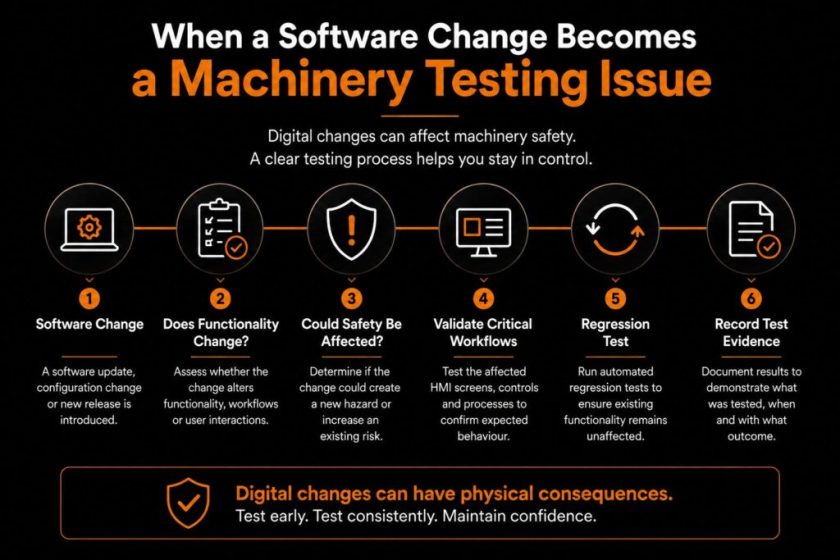
Machinery is becoming increasingly software-driven, the new EU Machinery Regulation puts greater focus on digital change, safety and the need to validate software throughout the machinery lifecycle.
The line between machinery and software is disappearing.
Manufacturing equipment increasingly depends on software, digital controls, operator interfaces and connected systems. A change to software can now alter how a physical machine behaves just as significantly as replacing a mechanical component.
From 20 January 2027, the EU Machinery Regulation (EU) 2023/1230 will apply, replacing the existing Machinery Directive 2006/42/EC.
For manufacturers, engineering teams and software developers, this creates an important question:
When software changes, can you prove the machinery and its critical digital workflows still behave as expected?
What Is the EU Machinery Regulation 2027?
The EU Machinery Regulation introduces an updated legal framework for machinery and related products placed on the EU market.
It reflects how significantly machinery has evolved since the existing Machinery Directive was introduced, with modern equipment increasingly incorporating software, connected technologies and autonomous functionality.
The Regulation covers much more than software testing, but there are important implications for organisations developing and maintaining software-dependent machinery.
In particular, it recognises that changes made by physical or digital means can affect the safety of machinery.
That makes software change something manufacturers cannot afford to consider in isolation.
Why Software Changes Matter
One particularly important concept within the Regulation is “substantial modification”.
A modification made after machinery has been placed on the market or put into service can be considered substantial if it was not foreseen or planned by the manufacturer and affects safety by creating a new hazard or increasing an existing risk.
Crucially, that can include changes made by digital means.
Depending on the circumstances, the person making a substantial modification can become responsible for meeting manufacturer obligations for the affected machinery.
That makes validating software changes increasingly important.
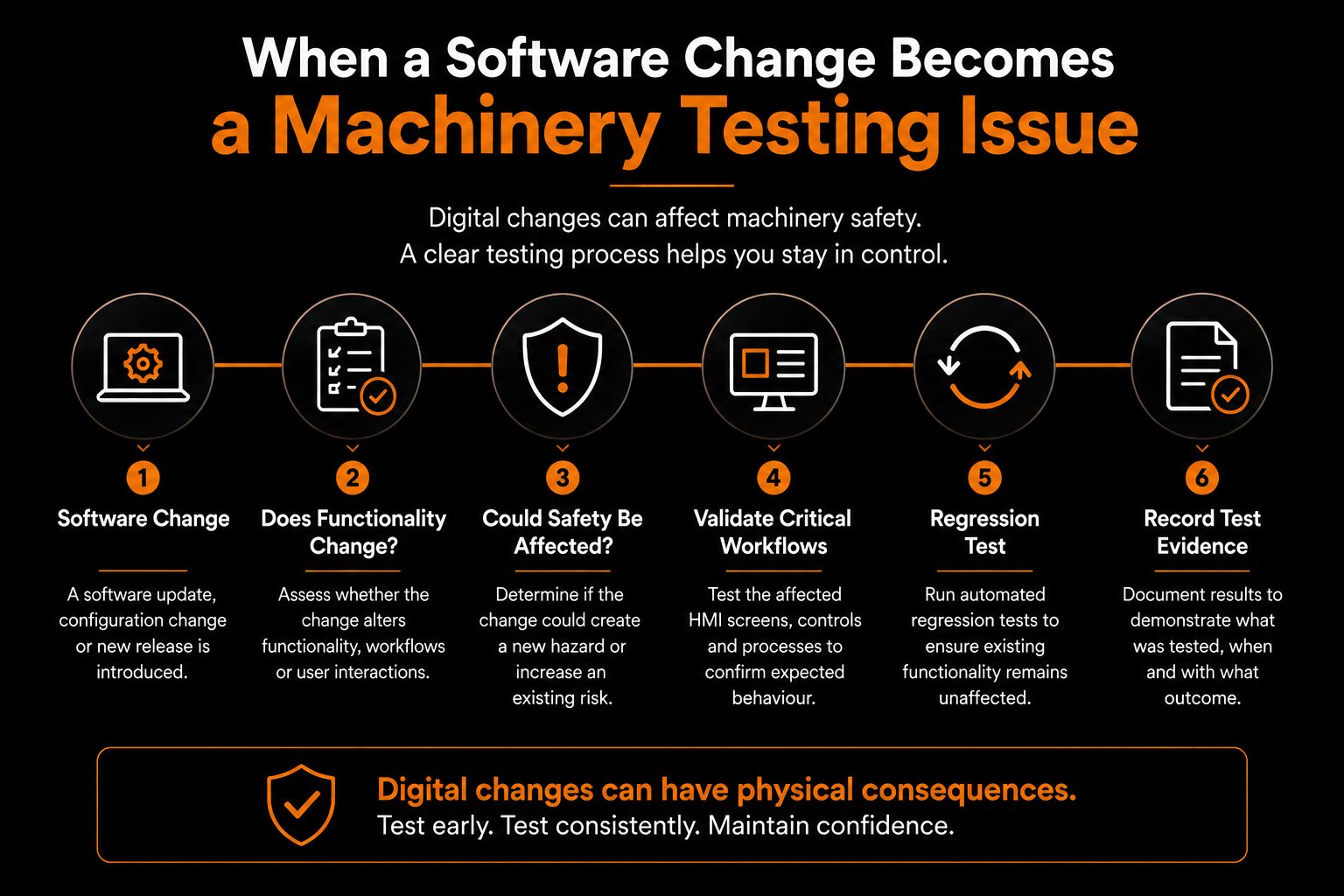
A software update might appear relatively minor, but organisations need to understand whether it has changed:
- Operator workflows.
- HMI behaviour.
- Controls or commands.
- Safety-related information.
- Application functionality.
- Interactions with other systems.
This is where repeatable software testing becomes valuable.
HMI Testing Becomes Part of the Picture
Human-machine interfaces (HMIs) are now fundamental to many industrial environments.
Operators use screens, dashboards, control panels and applications to interact with machinery, monitor processes and make decisions.
If an HMI changes, the underlying machine may remain mechanically identical while the way an operator interacts with it changes significantly.
- Buttons can move.
- Warnings can display incorrectly.
- Workflows can change.
- Information can fail to appear.
- Different screen resolutions can affect layouts.
These aren’t necessarily mechanical faults, but they can affect how machinery is operated.
Visual UI test automation provides a way to validate the interface from the operator’s perspective, checking that expected visual elements and workflows continue to behave correctly following software changes.
The Importance of Regression Testing
Software rarely changes once.
Security patches, feature updates, operating system changes and application upgrades can continue throughout the working life of machinery.
Every change introduces the possibility of unintended consequences elsewhere.
Regression testing helps answer a simple question:
Has this change broken something that previously worked?
Automating established workflows allows manufacturers and software teams to repeat the same tests following changes rather than rebuilding the validation process for every release.
This can improve consistency, accelerate testing and provide documented evidence that defined software workflows have been tested.
What About Legacy Machinery?
This is particularly important for manufacturing because machinery often has a much longer lifespan than the software surrounding it.
A machine might remain operational for 10, 15 or 20 years while its supporting technology changes repeatedly.
Operating systems reach end of support. Hardware is replaced. Applications are upgraded. Infrastructure becomes virtualised. Security requirements evolve.
Replacing the machinery itself may be unnecessary or commercially unrealistic.
The challenge becomes maintaining confidence in the software and interfaces that continue to support it.
Visual test automation can be useful in these environments because testing is based on what appears on screen rather than depending entirely on access to the application’s underlying code or technology.
That allows established and legacy applications to form part of an automated regression strategy alongside newer systems.
Machinery Regulation, Cyber Resilience and AI
The Machinery Regulation isn’t happening in isolation.
Manufacturers are entering an increasingly complex regulatory environment where physical products, software, cybersecurity and AI are becoming interconnected.
The EU Cyber Resilience Act introduces cybersecurity requirements for products with digital elements, while the EU AI Act introduces requirements around certain uses of artificial intelligence.
The regulations have different scopes and obligations, but together they illustrate a much broader change:
The regulation of physical products increasingly includes the software and digital technology that makes them work.
For manufacturers, software quality, cybersecurity, functional behaviour and product safety can therefore no longer always be treated as completely separate disciplines.
UK Cyber Security & Resilience
EU Cyber Resilience Act
What Should Manufacturers Be Doing Before January 2027?
The Regulation applies from 20 January 2027, so organisations affected by it should already be considering how software fits within their wider machinery assurance processes.
From a testing perspective, useful questions include:
- Which machinery relies on software or digital operator interfaces?
- Which workflows are critical to safe and reliable operation?
- How are HMIs currently tested after software changes?
- Are important regression tests still performed manually?
- Can testing be repeated consistently across software releases?
- Are legacy applications included in the testing strategy?
- Is there evidence showing what was tested and when?
The objective isn’t simply to automate more tests.
It’s to understand where a digital change could affect established functionality and ensure there is an effective way of validating it.
How T-Plan Supports Manufacturing Software Testing
T-Plan has more than 25 years of experience in visual UI test automation, helping organisations automate testing across modern, legacy and cross-platform software environments.
T-Plan Robot interacts with applications visually, enabling organisations to automate real user workflows without relying exclusively on an application’s underlying technology.
For manufacturing and engineering environments, this can support:
- HMI and user interface testing.
- Automated regression testing.
- Legacy application testing.
- Cross-platform validation.
- Testing across different screen resolutions.
- Repeatable software validation.
- On-premise and secure testing environments.
T-Plan does not provide Machinery Regulation compliance. Instead, test automation can form part of a wider software assurance strategy by helping organisations demonstrate that defined functionality has been tested consistently following change.
Preparing for Software-Defined Machinery
The EU Machinery Regulation reflects a fundamental change in modern manufacturing.
Machinery is no longer purely mechanical.
Software, interfaces, connectivity and increasingly intelligent systems influence how equipment behaves and how people interact with it.
As the 20 January 2027 application date approaches, manufacturers should consider whether their existing testing strategies have evolved at the same pace as their machinery.
Because when a software change can affect a physical process, software testing becomes part of a much bigger assurance picture.
Ready to Automate Software Testing Across Complex Systems?
T-Plan helps organisations automate UI testing across modern, legacy and cross-platform applications, from operator interfaces and specialist software to secure and business-critical systems.