As the UK strengthens cyber resilience requirements for essential and digital services, organisations need to consider not only how systems are secured, but how they can prove critical software continues to work when change occurs.
Cybersecurity is no longer simply about preventing an attack.
For organisations providing essential services, resilience also means maintaining the systems, applications and digital infrastructure that people and businesses rely upon every day.
The UK’s Cyber Security and Resilience (Network and Information Systems) Bill is designed to strengthen the country’s existing cyber resilience framework and expand the organisations covered by it.
The proposed legislation affects areas including healthcare, energy, drinking water, transport and digital infrastructure, while extending the regulatory framework to additional technology providers and data centres.
For IT, software development and QA teams, this creates an important question:
How do you demonstrate that critical software remains reliable when systems are patched, updated, recovered or changed?
Software testing may not be the headline of the Bill, but repeatable validation can play an important role in the wider operational resilience organisations are increasingly expected to demonstrate.
What Is the UK Cyber Security & Resilience Bill?
The Cyber Security and Resilience (Network and Information Systems) Bill was introduced to Parliament on 12 November 2025.
It proposes significant updates to the Network and Information Systems Regulations 2018, commonly known as the NIS Regulations.
The existing framework already places cybersecurity and resilience requirements on operators of essential services and certain digital service providers. The new Bill is intended to broaden and strengthen that framework as the UK’s dependence on interconnected digital services continues to increase.
Among its proposals are measures to:
- Bring additional organisations within the regulatory framework.
- Introduce data centres into the NIS regime as essential services where relevant thresholds are met.
- Strengthen the regulation of managed and digital service providers.
- Expand incident reporting requirements.
- Introduce stronger regulatory and enforcement powers.
- Allow requirements to evolve as technologies and cyber threats change.
The legislation is particularly significant because modern essential services rarely operate independently. Healthcare, utilities, transport, government services and other critical sectors increasingly depend on complex combinations of software, infrastructure, third-party suppliers and legacy technology.
A failure in one part of that ecosystem can therefore have consequences far beyond the organisation where the original problem occurred.
Where Is the Bill Now? Key Dates for 2026 and Beyond
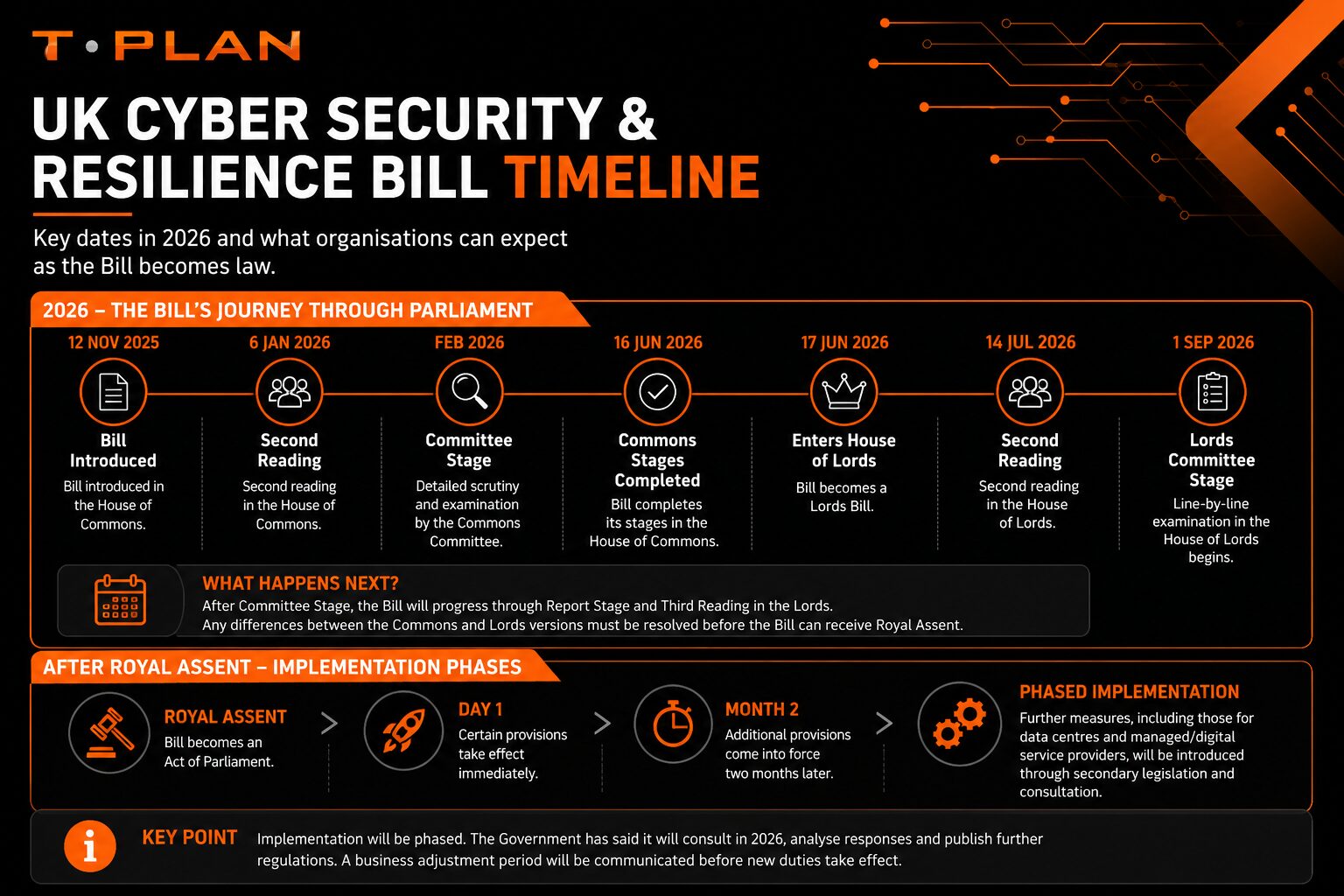
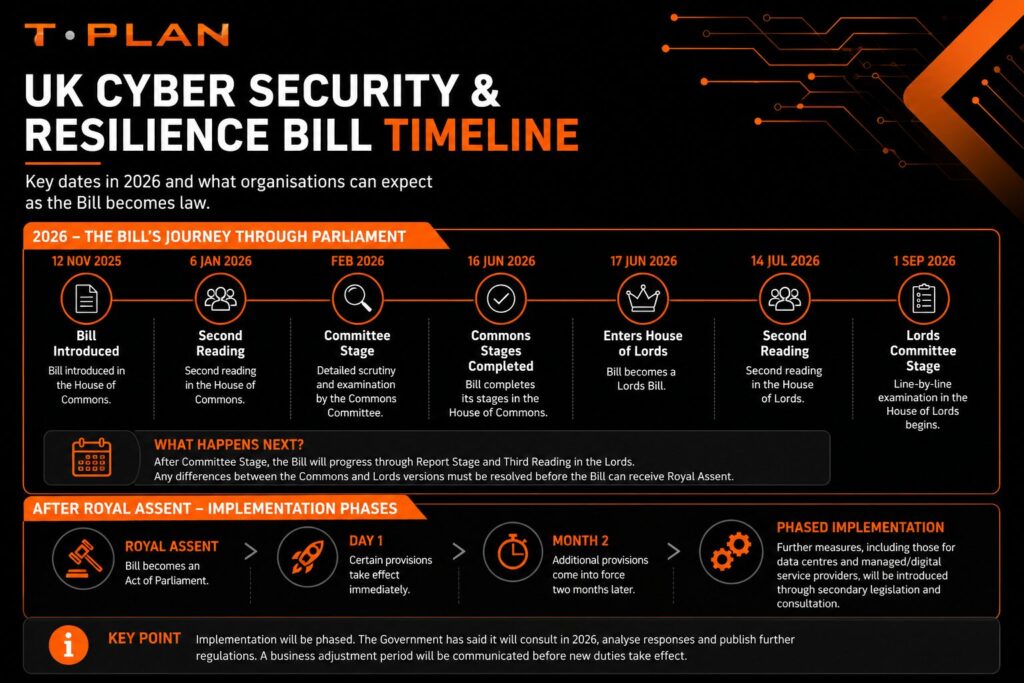
As of August 2026, the Cyber Security and Resilience Bill has already progressed significantly through Parliament.
12 November 2025
The Bill was introduced in the House of Commons.
6 January 2026
The Bill received its Commons second reading.
February 2026
Detailed scrutiny took place during the Commons Committee Stage.
16 June 2026
The Bill completed its Commons stages.
17 June 2026
The Bill entered the House of Lords.
14 July 2026
The Bill received its second reading in the House of Lords.
1 September 2026
The House of Lords Committee Stage is scheduled to begin, with detailed line-by-line examination of the Bill.
After Committee Stage, the Bill must still pass through Report Stage and Third Reading in the Lords. Any differences between the Commons and Lords versions must then be resolved before the Bill can receive Royal Assent.
This means organisations should be watching developments during the remainder of 2026 rather than waiting for a final compliance deadline.
What Happens After the Bill Becomes Law?
Royal Assent will not mean every new requirement becomes operational immediately.
The Government has said that implementation will be phased to give affected organisations and regulators time to prepare.
Some provisions are intended to take effect immediately when the legislation becomes an Act, while others would begin two months later.
More substantial operational requirements, including provisions affecting data centres and relevant managed and digital service providers, are expected to be introduced through secondary legislation.
That distinction matters.
The primary legislation establishes the regulatory framework, but further technical detail, thresholds and implementation requirements will continue to emerge afterwards.
For businesses, 2027 is therefore likely to be as important as 2026.
Rather than viewing Royal Assent as the end of the process, organisations should expect a period of regulatory implementation, consultation, secondary legislation and adjustment as individual requirements come into force.
Who Should Be Paying Attention?
The Bill is particularly relevant to organisations operating essential services and the technology companies that support them.
This includes sectors such as:
- Healthcare.
- Energy and utilities.
- Drinking water.
- Transport.
- Digital infrastructure.
- Data centres.
- Managed service providers.
- Relevant digital service providers.
But the implications can extend further.
Modern organisations rely heavily on technology supply chains. An essential service may depend on infrastructure providers, outsourced technology partners, software applications and managed services to maintain everyday operations.
The resilience of the service increasingly depends on the resilience of the entire technology ecosystem supporting it.
How Does the UK Bill Compare with the EU Cyber Resilience Act?
The UK’s Cyber Security and Resilience Bill forms part of a wider regulatory shift towards stronger digital and operational resilience.
Organisations operating internationally may also be preparing for the EU Cyber Resilience Act (CRA), which introduces cybersecurity requirements for products with digital elements placed on the EU market.
Although the two regimes have different scopes, there’s an important common theme: organisations are increasingly expected to take a more proactive and continuous approach to cyber resilience.
The CRA focuses heavily on the security of digital products throughout their lifecycle, while the UK Bill is primarily concerned with strengthening the resilience of essential and digital services and the technology supply chains supporting them.
For organisations operating across both the UK and EU, this means cyber resilience increasingly needs to be considered alongside software development, maintenance, updates and ongoing testing.
From a software testing perspective, the practical question is similar:
When software is patched, updated or changed to address security and resilience requirements, can you demonstrate that critical functionality still works as intended?
Repeatable regression testing can provide an important layer of assurance by validating software behaviour after change, while maintaining evidence that testing has taken place.
For a more detailed look at the EU requirements, read our Cyber Resilience Act Compliance Guide.
Incident Reporting Is Becoming Faster
One of the most significant proposed changes is the approach to reporting cyber incidents.
Under the Bill, regulated organisations would be required to provide an initial notification of a reportable incident within 24 hours of becoming aware of it, followed by a more detailed report within 72 hours.
The scope of reportable incidents would also broaden in certain circumstances, including attacks that could significantly affect UK services even where the full impact has not yet materialised.
This places greater importance on organisations understanding what has happened, which services are affected and what impact an incident may have.
And that leads to an important operational consideration.
Once an incident has been contained, how do you know the affected software still works?
Cyber Resilience Is More Than Cybersecurity
Security teams understandably focus on preventing attacks, detecting threats and protecting infrastructure.
Operational resilience asks another question:
Can the organisation continue operating?
A security patch may close a vulnerability but unintentionally disrupt an application.
An infrastructure change may strengthen security while affecting an established workflow.
A recovered system may successfully restart but behave differently from the environment that existed before the incident.
An operating system update may affect an application that has been running reliably for years.
And a change made to one component of a complex system can have unexpected consequences elsewhere.
For organisations providing essential services, discovering those problems after systems return to production can create significant operational risk.
Cyber resilience therefore needs to consider both security and functionality.
Where Software Testing Fits
The Cyber Security and Resilience Bill does not create a general requirement for organisations to implement UI test automation.
However, repeatable software testing can support the broader objective of building and maintaining resilient digital services.
Testing enables organisations to validate whether critical applications and workflows continue to behave as expected following:
- Security patches.
- Software updates.
- Infrastructure changes.
- Operating system upgrades.
- Disaster recovery.
- System restoration.
- Application migrations.
- Configuration changes.
Instead of relying entirely on manual checks after every change, automated regression testing allows predefined business processes to be executed consistently and repeatedly.
This can be particularly valuable where software supports essential or business-critical operations.
Why Repeatability Matters
Manual testing remains an important part of quality assurance, particularly for exploratory testing and areas requiring human judgement.
But resilience creates a different challenge.
Organisations may need to validate the same critical workflows repeatedly across multiple releases, environments and platforms.
Automation allows a test to be created once and executed consistently whenever the underlying system changes.
That provides three important advantages.
- Consistency
The same process can be executed in the same way every time. - Speed
Critical workflows can be validated significantly faster than repeating large manual regression suites. - Evidence
Test execution and results can be recorded, providing organisations with evidence that validation has taken place.
The objective is not simply faster software testing.
It is greater confidence that systems continue to perform their intended function after change.
The Legacy System Problem
One area organisations should not overlook is legacy technology.
Essential services frequently depend on applications that were developed years or even decades ago.
Replacing those systems is rarely straightforward. They may support highly specialised processes, integrate with other business-critical applications or require significant investment to modernise.
But older software still needs to survive modern change.
- Operating systems evolve.
- Infrastructure is replaced.
- Security vulnerabilities require remediation.
- Applications are migrated into virtual environments.
- Access controls change.
- Hardware reaches end of life.
Each change creates the possibility that an established application or workflow will behave differently.
This is where visual UI test automation can be particularly valuable.
Because visual automation interacts with the user interface rather than depending entirely on an application’s underlying code or object structure, it can enable organisations to automate applications where conventional automation frameworks may be difficult to implement.
Testing Across Complex Technology Environments
The technology supporting essential services is rarely confined to a single operating system or application type.
Organisations may need to maintain combinations of:
- Windows applications.
- Linux environments.
- Web applications.
- Mobile applications.
- Virtual desktops.
- Remote systems.
- Legacy applications.
- Specialist enterprise software.
A resilient testing strategy therefore needs to consider the complete user journey rather than individual technologies in isolation.
Cross-platform automation can help organisations validate critical workflows across these environments while reducing the need to maintain entirely separate testing processes for every platform.
Secure Testing Environments Matter Too
For organisations operating critical infrastructure or handling sensitive information, the testing platform itself can also become part of the security consideration.
- Cloud connectivity may be restricted.
- Systems may operate within segmented networks.
- Some environments may be entirely disconnected or air-gapped.
- Sensitive test information may need to remain within organisational infrastructure.
In these situations, organisations need automation approaches capable of operating within their existing security architecture rather than requiring applications or test data to leave the controlled environment.
This is particularly relevant across defence, government, healthcare, financial services and critical infrastructure.
How T-Plan Supports Secure and Resilient Software Testing
T-Plan has more than 25 years of experience helping organisations automate testing across complex, secure and business-critical software environments.
T-Plan Robot uses visual UI automation to interact with applications from the user’s perspective, allowing organisations to automate workflows without relying exclusively on the underlying application technology.
This enables testing across modern and legacy environments, including desktop, web, mobile and virtual applications.
Capabilities relevant to organisations considering their wider resilience strategy include:
- Visual UI test automation.
- Repeatable regression testing.
- Cross-platform validation.
- Legacy application testing.
- Virtual desktop testing.
- On-premise deployment.
- Testing within secure environments.
- Detailed execution reporting.
- Low-code and no-code automation.
For organisations responsible for essential or business-critical systems, this provides a way to repeatedly validate that important software workflows continue to function as systems evolve.
What Should Organisations Do During 2026?
The Bill is still progressing through Parliament, so organisations should avoid treating proposed requirements as final.
However, waiting until every implementation date has been confirmed may leave little time to understand existing technology dependencies.
There are practical steps organisations can take now.
- Identify Critical Software
Understand which applications and workflows are essential to delivering services. - Map Technology Dependencies
Consider the infrastructure, third-party services, operating systems and legacy applications those processes depend upon. - Review Existing Regression Testing
Determine whether critical workflows can currently be validated quickly following a security patch, update or infrastructure change. - Identify Manual Testing Bottlenecks
Look for areas where resilience testing depends heavily on individuals manually repeating the same processes. - Review Testing Evidence
Consider whether existing testing processes provide sufficient records of what was tested, when it was tested and what the outcome was. - Consider Secure Automation
Where applications operate within controlled, restricted or disconnected environments, assess whether the testing approach can operate within the same security constraints.
What Should Businesses Expect in 2027?
There is not currently a single confirmed date when all Cyber Security and Resilience Bill requirements will suddenly apply.
Instead, businesses should expect a phased implementation.
Following Royal Assent, some measures are expected to commence immediately or within two months. Other significant measures will depend on secondary legislation and further technical detail.
Managed service providers, for example, are expected to receive further detail covering appropriate security and resilience measures and the thresholds used to determine when incidents become reportable.
Once the relevant regulations are commenced, relevant managed service providers are expected to have three months to register with the Information Commissioner.
For affected organisations, 2027 could therefore become an important implementation and preparation year, as the framework moves from parliamentary legislation towards detailed regulatory requirements.
The sensible approach is to begin understanding technology dependencies and testing capability now rather than waiting for every deadline to be published.
Building Resilience Before It Becomes a Requirement
The Cyber Security and Resilience Bill reflects a wider change taking place across technology regulation.
Governments and regulators are increasingly focusing not only on preventing cyber incidents, but on whether organisations can maintain and restore the digital services society depends upon.
That changes the conversation around software testing.
Testing is no longer valuable only before a new application is released.
It can become part of an ongoing resilience strategy, helping organisations repeatedly validate that critical software continues to operate as expected when the technology around it changes.
For organisations running complex, legacy or security-sensitive systems, building that capability before new regulatory requirements take effect can provide a significant advantage.
Because when critical software changes, the question isn’t simply whether the change was successful.
It’s whether everything that depended on it still works.
Explore Secure Test Automation
Discover how T-Plan helps organisations automate testing across secure, legacy and cross-platform software environments.