A practical look at automation resilience, AI dependency and business continuity in an increasingly AI-driven world.
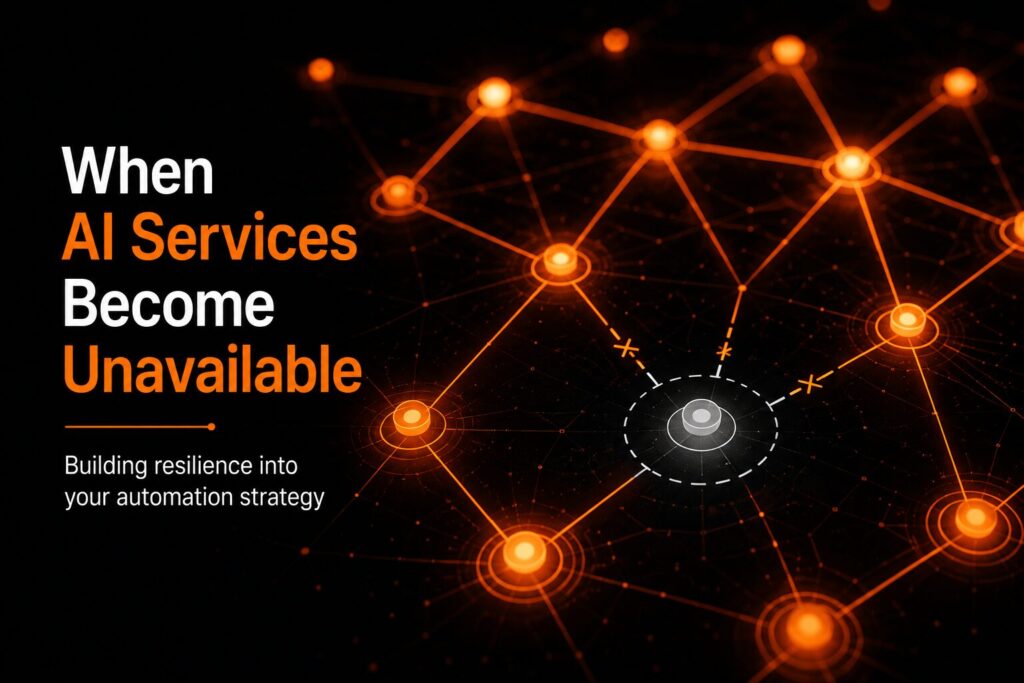
Recent restrictions affecting access to Anthropic’s advanced AI models have highlighted an important question for businesses adopting AI technologies: what happens when a service your team depends upon becomes unavailable?
While the circumstances surrounding the restrictions are specific to one provider, the situation raises broader questions about resilience, continuity and dependency in an increasingly AI-driven world.
Artificial intelligence is rapidly becoming part of modern software development, testing and business automation. From generating code and creating test cases to supporting customer service and operational processes, AI is helping organisations move faster than ever before.
However, as organisations integrate AI into business-critical workflows, they should also consider what happens when access changes, services are interrupted, or external dependencies fall outside their control.
AI Adoption Is Accelerating
The past two years have seen an explosion in AI-powered tools. Development teams are using AI assistants to write code, QA teams are experimenting with AI-generated test cases, and businesses are exploring AI-driven automation across a wide range of processes.
The potential benefits are significant. AI can help teams work more efficiently, reduce repetitive tasks and accelerate delivery times.
For many organisations, the question is no longer whether to adopt AI, but how deeply it should be embedded into day-to-day operations.
As adoption increases, so too does the importance of understanding where dependencies exist.
The Difference Between Using AI and Depending on AI
There’s a significant difference between using AI as a productivity tool and building critical business processes that cannot function without it.
Many organisations successfully use AI to support existing workflows. If the AI service becomes unavailable, work can continue, albeit at a slower pace.
The risk increases when organisations become dependent on AI services for essential functions.
For example:
- Automated testing processes that rely entirely on AI-generated outputs
- Business workflows that require external AI services to execute
- Development pipelines built around a single AI provider
- Customer-facing systems that cannot operate without AI functionality
In these situations, a service interruption can quickly become an operational issue rather than a productivity inconvenience.
Understanding the Risks
Technology providers can change pricing models, usage limits, access requirements or regional availability. Services can also experience outages, compliance restrictions or changes in regulatory oversight.
These situations are not unique to AI. Similar challenges have existed for years across cloud computing, SaaS platforms and third-party integrations.
What makes AI different is the speed at which organisations are adopting it and the growing tendency to position AI at the centre of critical workflows.
Businesses should therefore ask:
- What would happen if a key AI service became unavailable tomorrow?
- How long could operations continue without it?
- Is there an alternative process available?
- Are there compliance or security implications associated with the service?
- Does the organisation maintain sufficient control over its automation strategy?
These are governance questions as much as technology questions.
Why This Matters for Regulated Industries
For organisations operating in highly regulated sectors, resilience is often just as important as innovation.
Industries such as defence, healthcare, finance and government frequently face additional requirements around:
- Data security
- Compliance
- Auditability
- Business continuity
- Operational control
In these environments, technology decisions are rarely based solely on features and functionality. Organisations must also understand how systems will perform when circumstances change.
This is one reason why many enterprises continue to value automation solutions that can operate within controlled environments, support on-premise deployment and provide flexibility over where and how automation is executed.
Building Resilience Into Your Automation Strategy
The lesson isn’t that organisations should avoid AI. Far from it.
AI will continue to play an increasingly important role in software testing, automation and digital transformation initiatives.
The goal should be to adopt AI in a way that strengthens the organisation without introducing unnecessary operational risk.
A resilient automation strategy typically includes:
- Understanding Dependencies
Know where AI services are used and how critical they are to daily operations. - Avoiding Vendor Lock-In
Where possible, maintain flexibility rather than becoming entirely dependent on a single provider. - Planning for Service Disruption
Consider how teams would operate during outages or access restrictions. - Balancing Innovation and Governance
Evaluate new technologies through both a capability and risk-management lens. - Maintaining Control
Ensure critical processes remain visible, manageable and adaptable as business requirements evolve.
Looking Beyond the Headlines
The recent Anthropic situation will undoubtedly generate discussion across the technology industry. However, the broader lesson extends well beyond any individual provider.
As AI becomes increasingly integrated into software development, testing and business operations, organisations should think carefully about resilience, continuity and control.
The most successful automation strategies are rarely those built around a single technology trend. They are the strategies designed to adapt as technologies, regulations and business requirements evolve.
AI will continue to transform the way organisations work.
The challenge is ensuring that the systems and processes built around it remain resilient enough to support the business, whatever the future may bring.
Conclusion
At T-Plan, we’ve spent more than 25 years helping organisations automate testing and business processes in environments where reliability, security and control matter.
From defence and healthcare to finance and government, many of our customers choose automation solutions that can operate within their own infrastructure, support compliance requirements and continue delivering value as technologies evolve.
While AI will undoubtedly play an important role in the future of automation, the organisations that achieve the greatest long-term success will be those that balance innovation with resilience.
The future of automation is intelligent. The challenge is ensuring it remains resilient too.