
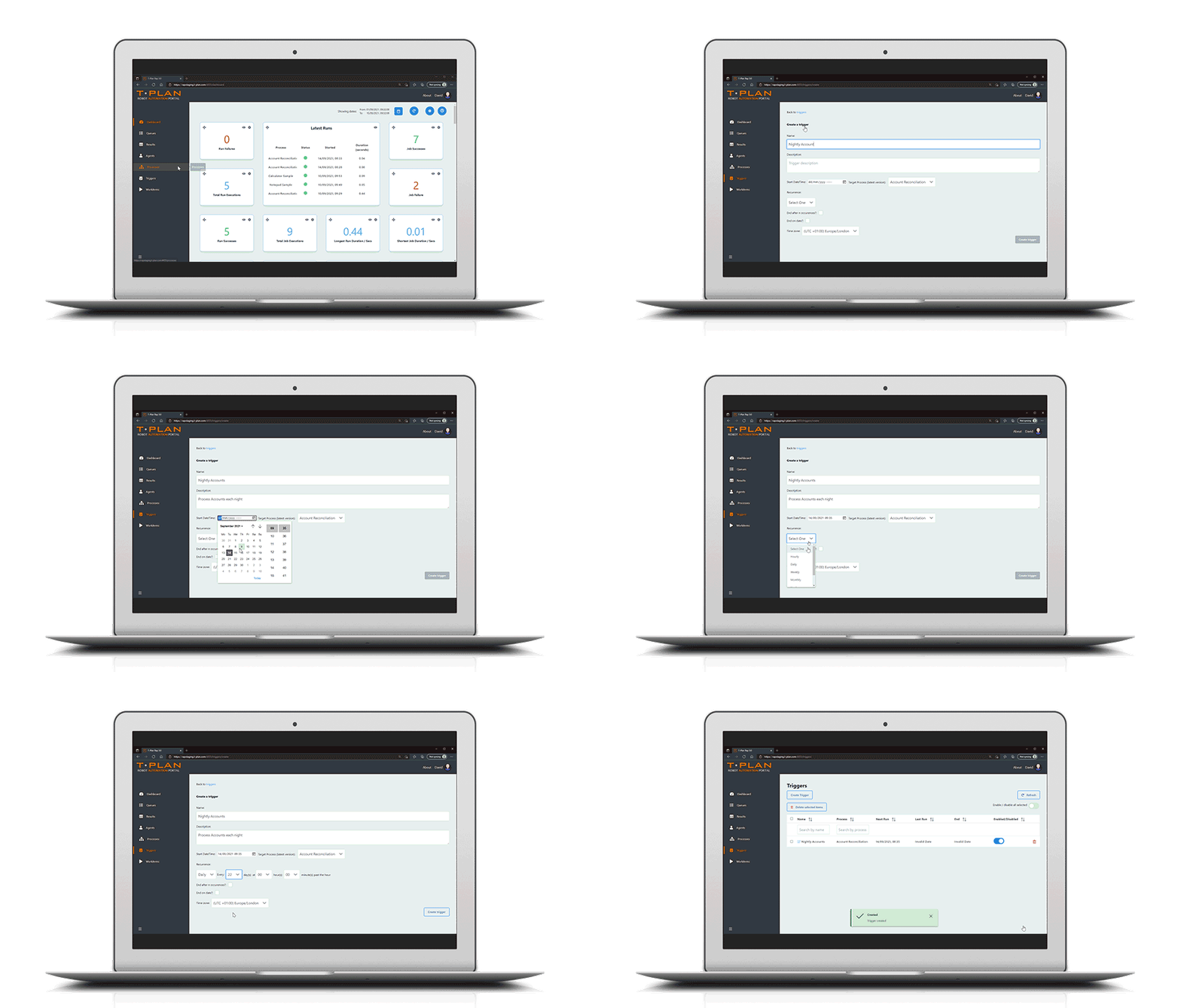
Enterprise software testing focuses on verifying the stability, performance and integration of business-critical systems. It typically includes system testing, integration testing and end-to-end workflow validation across multiple applications.
Enterprise Application Testing & Automation
Enterprise systems are complex, interconnected and business-critical. Effective enterprise application testing requires scalable automation that can validate workflows across web, desktop and legacy environments without disrupting production systems.
- Validate cross-system business processes end to end
- Support enterprise software testing across legacy and modern platforms
- Deliver scalable test automation in secure environments
- Maintain audit-ready enterprise quality assurance.
Built for Complex Enterprise Software Ecosystems
Enterprise environments rarely operate in isolation. Business workflows span ERP platforms such as SAP and Oracle, CRM systems like Salesforce, bespoke web applications, desktop clients and virtualised environments.
T-Plan provides enterprise-grade automation across this mixed estate, enabling scalable enterprise application testing and end-to-end workflow validation without relying on fragile code-level integrations. By operating at the visual interface layer, organisations can maintain security, control and auditability while supporting enterprise quality assurance at scale.
Enterprise Application Automation
NON-INVASIVE • COMPUTER VISION VALIDATION • SCALABLE AUTOMATION
Why Choose T-Plan for Enterprise Application Testing & Automation?
Enterprise environments demand stability, security and scale. T-Plan enables enterprise application testing across complex software ecosystems without requiring intrusive integrations or fragile code-level hooks.
By operating at the visual interface layer, T-Plan supports enterprise test automation strategy across ERP, CRM, legacy desktop and modern web systems within a single automation framework.
Key advantages:
- Non-invasive validation across secure and controlled environments
- One platform for web, desktop and legacy enterprise software testing
- Scalable test automation across distributed infrastructures
- Enterprise-grade automation with full auditability and repeatability
Why Test and Automate Enterprise Applications?
Enterprise systems support corporate software testing and critical business operations. As platforms grow in complexity and release cycles accelerate, manual validation becomes slow, inconsistent and difficult to scale.
Enterprise software testing and automation improve reliability while reducing operational risk. Structured automation ensures business workflows function correctly across interconnected systems, helping organisations maintain quality, compliance and performance at scale.
Enterprise automation supports:
- Faster validation of cross-system workflows
- Reduced regression risk during upgrades and integrations
- Improved enterprise quality assurance across teams
- Consistent, repeatable validation in secure environments
Testing Legacy and Business-Critical Enterprise Applications
Enterprise organisations often rely on legacy software, desktop applications and highly customised internal systems that are difficult to automate using traditional testing tools.
T-Plan’s image-based approach enables testing across legacy and modern enterprise applications without requiring source code access, APIs or extensive application modifications.
Common Enterprise Testing Challenges
- Legacy applications with limited automation support
- Desktop and thick-client software
- Highly customised internal business systems
- Applications operating within secure environments
- Mixed modern and legacy technology stacks
- Systems with limited API access
- Cross-platform enterprise deployments
Trusted by Hundreds of Companies and Used by Thousands of People for Over 25 Years




























Bank of England Case Study
T-Plan enabled the Bank of England to define and manage a fully traceable QA strategy, linking requirements through to test execution within a controlled, auditable framework.
The platform allowed the team to centralise test management, maintain visibility across changing project scope and improve delivery efficiency, reducing planned QA resource from 15 to 11 while maintaining full oversight.
The CMMO (Central Money Markets Office) was delivered on time and within budget… In a project of this size and complexity, this is no small achievement; it is something in which the Bank as a whole can take some pride."

Deputy Chief of the Banking Department and Deputy Chief Cashier
Bank of England
Enterprise-Grade Automation Capabilities
Enterprise environments demand automation that is scalable, secure and capable of validating complex cross-system workflows. T-Plan enables enterprise application testing and enterprise test automation across web, desktop and legacy platforms without intrusive integrations.
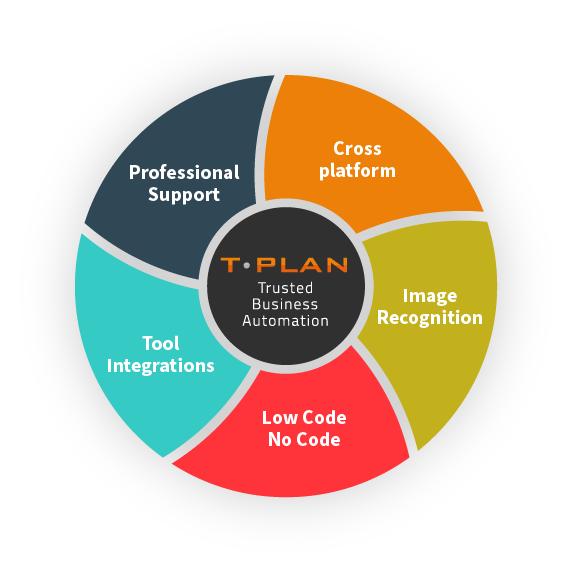
No-Code/Low-Code
Automation
Enable technical and business teams to build scalable enterprise test automation without complex scripting frameworks.
Create Once, Reuse Across Environments
Define workflows once and execute them across development, test, UAT and production environments.
Record and
Playback
Capture real user interactions across enterprise applications for consistent, repeatable regression validation.
External Data
Integration
Drive enterprise application testing using structured data from databases, APIs and business systems.
Interface-Level
Automation
Interact directly with web, desktop and packaged enterprise platforms without intrusive agents or code modification.
Multi-Platform
Support
Execute automation across Windows, Linux, virtualised environments and mixed enterprise infrastructures.
Visual
Validation
Verify outputs exactly as users see them across complex enterprise software interfaces.
Third-Party
Integrations
Align with release management processes, DevOps pipelines and enterprise tooling to support structured end-to-end validation.
Platform Agnostic, Seamless Integration
Integration Capabilities
Integrates with a range of tools, including Selenium for script-less automated browser testing, and Jenkins for continuous integration, saving time & effort vs building and maintaining external testing frameworks.
Platform Agnostic
Automates GUI testing seamlessly across web and mobile platforms, supporting both Mac, Windows, and Linux environments with unified application, code, and file compatibility.
Image Recognition
Providing essential user feedback directly from the end-user’s perspective. Validated based on what is visually observed, not solely on the code’s output.
Code -Free Automation
An intuitive user interface designed for both technical and non-technical users, featuring drag-and-drop functionality. No Code / Low Code.
Enterprise Application Testing FAQs
Enterprise application testing is the structured validation of complex business systems such as ERP, CRM and integrated enterprise platforms. It ensures that cross-system workflows, user interfaces and data exchanges function reliably across development, test and production environments.
Enterprise test automation uses scalable automation frameworks to validate large, interconnected software ecosystems. It enables repeatable regression testing, workflow validation and enterprise quality assurance across web, desktop and legacy platforms.
An enterprise automation framework provides the structure and tools needed to automate testing across complex systems at scale. It supports reusable components, data-driven execution, integration with release processes and operation within secure or controlled environments.
Legacy application testing is the process of validating older or business-critical software systems to ensure they continue to function correctly after updates, integrations or infrastructure changes. These applications often include desktop software, customised business systems, ERP platforms and internally developed tools that may have limited API access or use older technologies. Effective legacy application testing helps organisations reduce risk, maintain reliability and support ongoing digital transformation initiatives.
Scalability in automation testing refers to the ability to execute tests across multiple environments, systems and configurations without compromising stability or performance. Scalable test automation supports distributed execution and large regression suites.
Testing an enterprise application involves validating end-to-end business workflows, system integrations, data integrity and user interface behaviour. Modern enterprise testing combines manual validation with automation to ensure stability during upgrades, migrations and cross-system integrations.