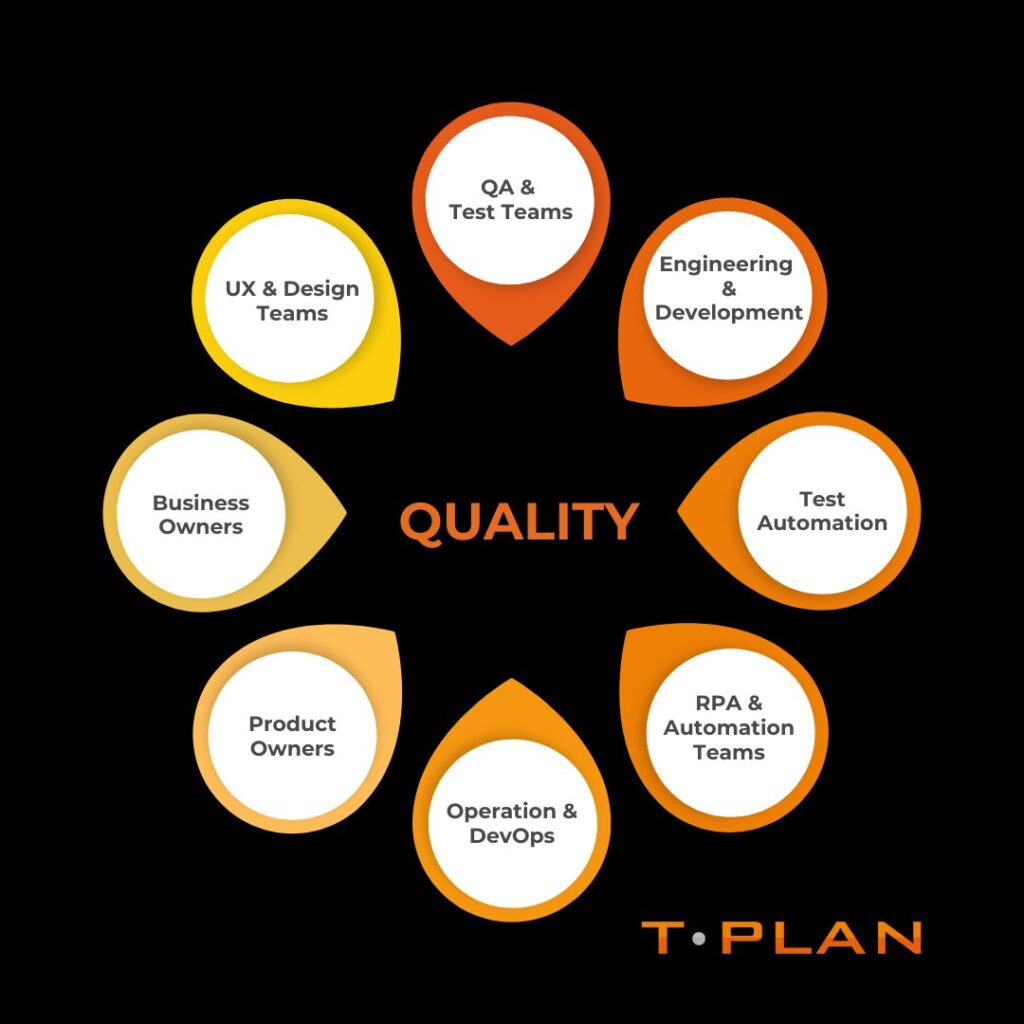
Ownership used to feel clear. QA teams planned it, executed it and carried responsibility for quality. Other roles contributed, but accountability was understood.
Today, that clarity has shifted. Automation is everywhere, delivery cycles are shorter and responsibility for quality now spans QA, development, operations and the business itself. Testing happens across pipelines, platforms and processes, often without a single point of coordination.
So who actually owns testing today?
The reality is that ownership has become shared. The challenge is making that shared model work in practice.
How Testing Responsibility Became Distributed
Modern delivery models have reshaped how teams operate. Agile and DevOps encouraged faster feedback and closer collaboration, but they also dismantled traditional boundaries.
Developers write unit and integration tests.
QA teams focus on automation frameworks and coverage.
Operations teams monitor live systems.
Business teams automate workflows using RPA tools.
Each of these activities supports quality, but none of them alone provides a complete view. Testing is no longer a phase or a single role. It is a set of responsibilities spread across the lifecycle.
When this distribution is intentional, it works well. When it is accidental, gaps appear.
Automation has undoubtedly improved speed and repeatability. It allows teams to validate more scenarios more often. However, automation has also shifted the focus of testing away from exploration, judgement and observation.
This shift has raised genuine concerns within the testing community. Many experienced testers worry that testing is increasingly equated with execution, rather than investigation. Metrics improve, but understanding doesn’t always keep pace.
Automation supports testing, but it does not define it. Someone still needs to decide what matters, what to trust and where risk sits.
Why UI Complexity Brings Ownership Questions into Focus
Ownership challenges become most visible in systems dominated by complex user interfaces.
Desktop applications, EPOS platforms, engineering tools and legacy systems rarely behave like modern web applications. Visual layout, rendering, timing and interaction patterns are central to how these systems work.
In these environments, logic-level testing and object-based automation only tell part of the story. Responsibility for validating what users actually see can easily fall between teams.
This is where visual UI automation changes the dynamic. It provides a common, accessible way to validate behaviour across systems, regardless of whether the goal is software testing or process automation.
Where RPA and Testing Now Overlap
RPA has further blurred traditional ownership lines.
Automated business processes often span multiple applications and interfaces. They’re created outside of development teams, change frequently and can fail without obvious signals.
In many organisations, these workflows are not tested with the same discipline as application code, even though their impact can be just as significant.
Using the same visual automation approach, like T-Plan, for both testing and RPA helps close this gap. When one tool supports both use cases, teams gain a shared view of system behaviour rather than fragmented ownership split by tooling.
What Practical Ownership Looks Like Heading into 2026
Ownership of testing doesn’t need to revert to a single team, but it does need structure.
Organisations that are managing this well tend to focus on clarity rather than control. They make conscious decisions about:
- Who defines test strategy and risk
- How automation supports, rather than replaces, testing judgement
- How RPA workflows are validated alongside applications
- How UI behaviour is verified across systems
- How tools enable collaboration across roles
In these environments, QA evolves into a guiding discipline rather than a bottleneck. Testers help shape quality decisions, not just execute scripts.
Supporting Shared Ownership in Practice
As ownership of testing continues to evolve, one thing becomes clear. Quality today depends less on where testing sits organisationally and more on how well teams can collaborate across boundaries.
In many organisations, ownership is now split across QA, engineering, operations and business teams, often with very different skill sets and priorities. Some teams write code daily. Others automate processes visually. Many sit somewhere in between. Tools that assume a single type of user or a single automation model struggle to support this reality.
This is where T-Plan has consistently stood apart. By using a visual, image-based approach, T-Plan supports both software test automation and RPA within the same platform. That makes it easier for teams with mixed skills to work together, share responsibility and maintain confidence across complex systems.
Rather than forcing ownership into rigid roles, T-Plan enables quality to be validated wherever it matters, whether that is a desktop application, an EPOS system, a legacy interface or an automated business process. The same approach can be used by testers, engineers and operational teams, without requiring everyone to become a specialist developer.
As organisations move into 2026, ownership of testing will continue to be shared by necessity. The teams that succeed will be those that choose tools designed for that reality. Tools that make collaboration easier, visual validation clearer and responsibility for quality more explicit, even when teams and skills are split.
In that sense, supporting modern test ownership is less about changing who owns testing, and more about enabling everyone involved to contribute effectively.